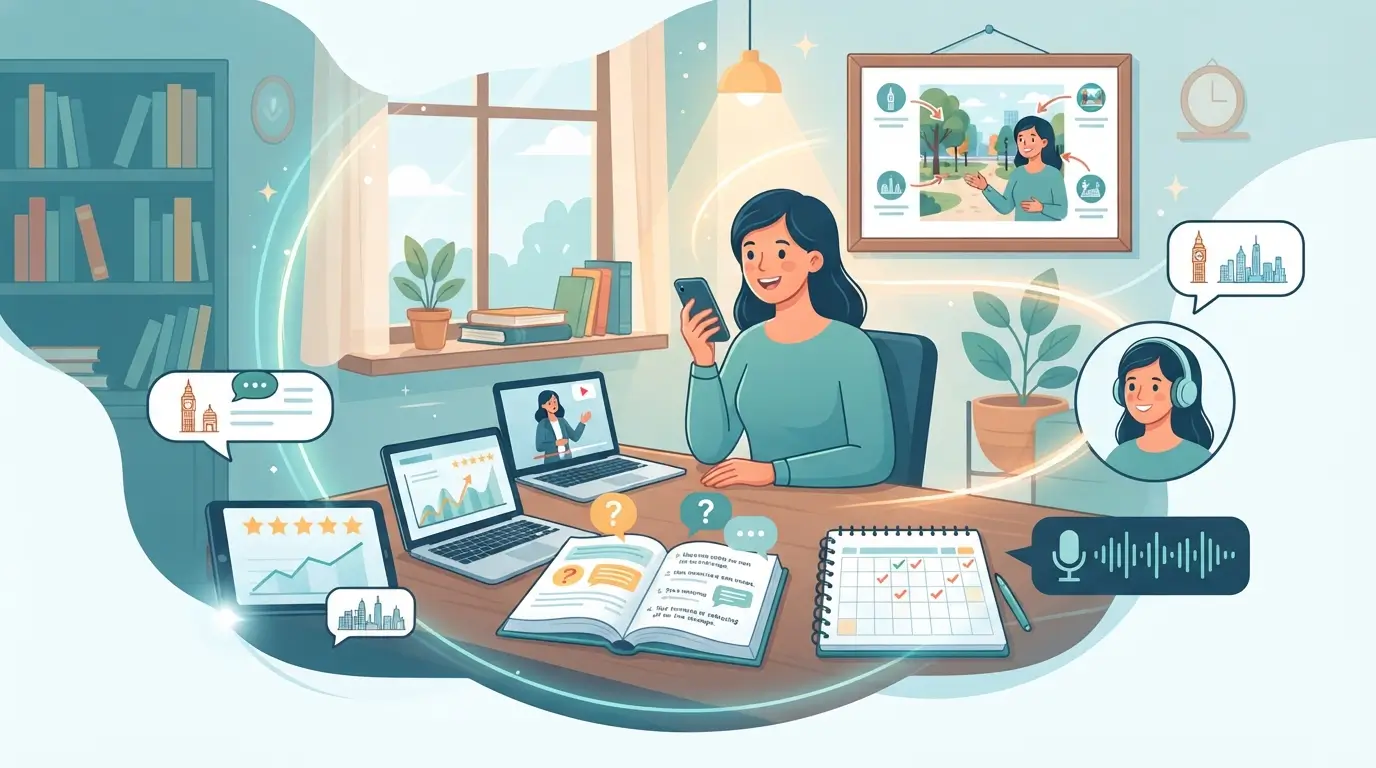
Ever opened an English book, studied for a solid hour, and then gone completely blank the moment someone actually spoke to you in real time?
That happens to almost everyone at some point.
Learning English alone can feel harder than it should, mostly because there's no teacher standing beside you correcting every mistake or telling you what to study next. Self-study does hand you something valuable in return, though: actual freedom. You get to pick topics you're genuinely interested in, practice whenever actually suits you, and fold English into an ordinary day rather than waiting for a scheduled lesson.
The real trick isn't studying for five hours on a Saturday and then forgetting English exists for the next six days. Progress tends to come from small, repeated contact with the language instead.
Here are twelve practical strategies for turning ordinary parts of your day into genuine English practice.
1. Set a Clear Goal Before You Start
"Improve my English" sounds like a reasonable goal, and it's actually too vague to guide any single day of practice.
A better starting question: what do you actually want to do with English? Speak confidently at work. Follow a movie without subtitles. Talk comfortably with international colleagues. Write cleaner emails. Prepare for an interview. Travel with less friction. Sharpen pronunciation. Build vocabulary.
Once the reason's clear, smaller targets follow naturally. "I want to speak English fluently" is a large goal that's hard to act on directly. "I will speak English aloud for 15 minutes every day for the next 30 days" is a smaller one that's actually measurable.
The SMART framework works here too — specific, measurable, achievable, relevant, time-based. The point was never becoming perfect quickly. It's making progress visible enough to actually notice.
2. Build a Simple English Study Plan
One of the bigger problems with self-study isn't a shortage of material. It's the opposite — genuinely too much of it.
Thousands of videos, apps, books, podcasts, websites, courses, vocabulary lists, and grammar exercises exist online, and trying to touch all of them tends to produce studying that's scattered rather than actually effective.
A simple weekly routine tends to work better: Monday vocabulary and speaking, Tuesday listening and pronunciation, Wednesday grammar and writing, Thursday speaking and vocabulary again, Friday TV or video listening, Saturday conversation practice, Sunday review and a progress check.
The exact shape doesn't matter much. What matters is giving each skill regular, repeated attention rather than binging one and ignoring the rest — a balanced plan tends to touch listening, speaking, reading, writing, vocabulary, and grammar over time, not all in one sitting.
3. Surround Yourself With English
Moving to the UK, the US, Canada, or Australia was never actually required for this. A small English-speaking environment builds fine at home.
Switch your phone or a few chosen apps to English. Read news headlines in English. Write the shopping list in English. Search Google or YouTube with English phrases.
Labeling ordinary objects around the house works too — mirror, refrigerator, window, desk, cupboard, pillow, charger. It feels a little strange at first. After a while, those words settle in without any deliberate memorizing at all.
Narrating your own actions helps too: "I need to make some coffee." "I have to answer this email." "I'm going to clean my desk." Small stuff, genuinely, but it connects English to actual life instead of treating it like a school subject that stays behind at a desk.
4. Practice Speaking English Even When You Are Alone
Here's the idea that tends to matter most for anyone learning independently: another person was never strictly required to start speaking.
Real conversations are genuinely valuable, no argument there. But fluency can build through talking to yourself first.
Describe what's actually in the room. Narrate what happened today. Explain how you'd solve some problem. Retell the plot of a movie you just watched.
"I woke up at seven this morning. I was running late, so I skipped breakfast. I took the bus to work, and on the way I listened to an English podcast" is the kind of sentence worth building toward.
It'll feel awkward the first several times. That's normal, and it fades. The whole point is training your brain to produce English directly, without routing every sentence through your first language first.
Try the "One-Minute Challenge"
Pick a topic and talk continuously for one minute: your job, your hometown, your favorite movie, a difficult day at work, weekend plans, a place you'd like to visit, a skill you want to learn.
Recording yourself helps. Listening back, worth noticing: which words got repeated, where the hesitation showed up, and which sentences could've come out more naturally. Fixing one or two things per recording beats trying to fix everything at once.
5. Use Your Phone to Check Whether You Are Speaking Clearly
A smartphone turns into a surprisingly useful practice partner here.
Speech-to-text or voice recognition, used naturally, can flag something worth examining — if the phone keeps misreading the same word or phrase, that's a signal worth investigating.
None of this makes speech-recognition software a perfect judge of pronunciation. It genuinely isn't one. It's just a rough, useful signal about clarity.
Start slow. Finish each word properly. Pay attention to the sounds that actually give you trouble. Then gradually speed back up to something closer to natural pace.
The long-term goal was never speaking unnaturally slowly forever. It's clear pronunciation other people can actually follow comfortably.
6. Turn Silent Videos Into Speaking Practice
YouTube isn't only for watching English lessons directly.
A short video with little or no dialogue — a silent comedy scene, a visual story, a short clip — works well here. Watch it once. Then turn it off and describe what happened, as if narrating it for someone who wasn't watching.
"A man walks into a room" is fine, but pushing further gets more out of the exercise: "A man slowly walks into the room and looks around as if he's searching for something. He notices a small box on the table, picks it up, and appears surprised by what he finds inside." More vocabulary, more grammar, more actual descriptive language.
This one works well specifically because the visual content is already understood — all the effort goes toward expressing it in English, not figuring out what happened in the first place.
7. Describe Photos in English
An existing photo gallery doubles as a genuine vocabulary resource.
Pick a photo and describe it out loud, as if the listener can't actually see it. What would they need to know? People, clothing, colors, locations, objects, facial expressions, weather, background details, positions, emotions, what might have happened just before or after the photo was taken.
"There are three people standing near a restaurant. The woman on the left is wearing a dark jacket, while the man beside her is holding a small backpack. It looks like they might be waiting for someone" is worth studying closely — notice "it looks like they might be," which is exactly the kind of flexible, natural phrasing worth building toward, rather than memorizing isolated vocabulary in a list.
8. Learn English Through Things You Already Enjoy
English practice gets considerably easier once it's tied to something genuinely enjoyed rather than studied out of obligation.
Cooking videos in English for anyone who cooks. An English-language workout for anyone who exercises. English football commentary for football fans. Product reviews in English for the tech-curious. Photography channels in English for anyone into photography.
Vocabulary tied to a real interest tends to stick considerably better than a random list ever does. Someone into fitness, for instance, ends up absorbing words like stretch, balance, strengthen, muscles, posture, repetition, flexibility — not because they memorized a list, but because they needed those words to actually follow something they cared about.
9. Learn One Phrasal Verb and One Idiom Each Day
Phrasal verbs and idioms frustrate a lot of learners because their meanings rarely follow logically from the individual words.
Rather than cramming thirty into one sitting, slowing down tends to work better — one useful phrasal verb and one idiom per day.
Phrasal verb: put off, meaning delay something. "I keep putting off my English homework." Idiom: break the ice, meaning make people more comfortable at the start of a conversation. "I told a funny story to break the ice."
Then actually use both during the day. Write them in a phone. Put them in a notebook. Build a personal sentence around each. Notice them when they show up elsewhere in reading or listening.
The real goal was never recognizing the expression on a page. It's having it ready the moment it's actually needed mid-conversation.
10. Learn English From TV Shows and Movies the Smart Way
Watching English-language movies for entertainment is genuinely enjoyable, and passive watching alone won't dramatically move the needle on its own.
Making it active helps. A show or movie already familiar works best — knowing the story already frees up attention for the language itself.
Keep a notebook nearby. An unfamiliar word or a genuinely useful expression goes down on paper, then the watching continues. Stopping every ten seconds to translate turns an enjoyable evening into exhausting homework, which tends to kill the habit fast.
Afterward, review the list. Whatever appeared more than once is probably worth actually learning. Then build a personal sentence around it — "I'm running late" becomes "I'm running late, so I'll take a taxi," which sticks considerably better than the bare translation ever would, since it's tied to something personal.
What About Subtitles?
Worth using strategically rather than by default. English subtitles help when the dialogue's genuinely hard to follow; skip them once most of a scene makes sense without help.
A short scene watched twice works well too — once for meaning, once specifically for language. That small adjustment alone tends to make video practice considerably more productive.
11. Train Your Ear With Different English Accents
Plenty of learners get comfortable with one particular accent and then feel genuinely lost the moment a different one shows up.
Real-world English is considerably broader than any single accent. Speakers might come from the United States, the United Kingdom, Australia, Canada, Ireland, New Zealand, South Africa, India, Singapore, and plenty of other English-speaking communities well beyond that list.
Mastering every accent was never the goal. Gradual exposure to different voices is. Podcasts, interviews, documentaries, news reports, and videos from a genuinely varied set of speakers all help.
When something's hard to follow, it's worth actually asking why — unfamiliar vocabulary? Fast speech? Connected words running together? Slang? A different pronunciation pattern entirely? That kind of listening tends to prepare you for the English actually encountered outside a textbook, which sounds considerably less tidy than textbook audio ever does.
12. Measure Your Progress and Stay Consistent
One of the harder parts of learning alone is simply not knowing whether it's actually working.
Which is exactly why keeping some evidence of progress matters.
Record Yourself
The same topic, recorded for two or three minutes, once a month — "Tell me about your job," say. Keep every recording. Months later, the older version compared against the newest one tends to reveal real change: less hesitation, longer sentences, ideas explained more easily than before.
Keep a Short English Journal
No need for a full essay each night. Five sentences is plenty — something like a quick account of a busy workday, a meeting, a moment of nerves that went better than expected, and tomorrow's task. Gradually reaching for more precise vocabulary and more varied sentence structure over time is where the actual growth shows up.
Check Your Vocabulary
Returning to a text or video used several weeks back tends to reveal something concrete. Does more of it make sense now? Do expressions register without translating? Can a few of them actually get used unprompted? Those small shifts are real signs of progress, even when they don't feel dramatic in the moment.
A Simple 30-Minute English Routine
None of this needs several hours a day. Thirty minutes covers a surprising amount of ground.
Fig. 1 — A simple 30-minute self-study routine
5 minutes — vocabulary: review five recently encountered words or phrases. 10 minutes — listening: a short podcast, interview, video, or TV scene. 10 minutes — speaking: talk about what was just heard, describe the day, or answer a question aloud. 5 minutes — writing: five sentences using the new vocabulary.
That's genuine contact with several skills inside one short session. More time available just means extending these, not replacing the structure entirely.
What If You Make Lots of Mistakes?
You will. Repeatedly. That's not evidence of failing — it's usually evidence of actually reaching past the current comfort zone, which is exactly where growth happens.
The real problem was never making the mistake. It's never actually examining it afterward.
Rather than "my English is terrible," a more useful question: "what exactly did I get wrong, and how do I say it differently next time?"
A small mistake notebook helps here. My sentence: "I am working here since 2022." Better version: "I have been working here since 2022." Then a fresh example built on the correction: "I have been learning English for three years." That turns a mistake into actual practice material instead of just a moment of embarrassment.
The Biggest Mistake When Learning English Alone
There's one trap a lot of self-learners fall directly into: collecting resources instead of actually using them.
Fifty saved YouTube videos. Five downloaded apps. Three grammar books bought and barely opened. Enormous vocabulary lists that never get reviewed. And, somewhere in all of it, speaking quietly avoided the whole time.
More resources don't automatically produce better results — a smaller set, used consistently, tends to outperform a huge pile used sporadically. Picking a few reliable materials and building an actual routine around them beats accumulation every time.
Use English. Don't just study English. That one distinction genuinely changes how this whole process goes.
How Long Does It Take to Learn English by Yourself?
No universal timeline exists here, whatever a course advertisement might promise.
Progress depends on where you're actually starting, how often practice happens, how much English shows up in daily life, what the actual goals are, and what kind of practice gets done. Twenty minutes of genuinely active speaking daily tends to produce a different trajectory than two hours of grammar study once a week, even though the total time might look similar on paper.
Instead of "how many months until fluent," a more useful question: "what can I actually do in English today that I couldn't three months ago?" That one's answerable, and it tracks something real.
Frequently Asked Questions
Can I really learn English by myself?
Yes. Vocabulary, grammar, reading, listening, pronunciation, writing, and speaking can all develop through self-study. Real conversations with other people still add something extra, though — spontaneous communication and live feedback that's harder to replicate alone.
How can I learn English by myself at home?
A daily routine covering listening, speaking, reading, writing, vocabulary, and grammar tends to work well. Watching English videos, reading articles, keeping a journal, speaking aloud, using voice recording, and practicing conversations solo all fit inside that.
How can I practice speaking English alone?
Describing your surroundings, telling stories, explaining opinions, retelling movie scenes, describing photographs, or recording yourself answering questions all work. Speaking aloud regularly tends to build speed and comfort forming sentences faster than silent study alone.
How many hours should I study English every day?
No single ideal number exists. Even 20 to 30 minutes of focused daily practice tends to be useful when kept up consistently. Longer sessions help too, but consistency usually matters more than occasional marathon sessions.
How can I improve my English listening skills?
Regular listening, with gradually varied speakers, accents, speeds, and subjects, tends to build this steadily. Podcasts, interviews, TV shows, movies, documentaries, and YouTube videos all provide useful practice.
How can I learn English vocabulary without forgetting it?
Definitions alone rarely stick. Learning words in context, building personal sentences, reviewing regularly, and actually using new vocabulary in speaking or writing tends to work better — words connected to real situations are considerably easier to remember.
Is watching English movies a good way to learn English?
Yes, especially watched actively. Familiar movies or shows, attention to useful expressions, strategic subtitle use, and repeating interesting phrases all help. Retelling scenes aloud afterward turns watching into genuine speaking practice.
How can I stay motivated while learning English alone?
Connecting English to things already enjoyed tends to help most — videos about real interests, music, reading about subjects that genuinely matter to you, and small, realistically achievable goals. Tracking progress also helps, since it's a reminder that the effort is actually producing something.
What Small Piece Will You Practice Today?
Learning English alone was never about learning English without any support at all. It's really about taking responsibility for creating regular chances to actually use the language.
Listen while cooking. Speak while walking. Describe a photo. Write about the day. Watch something already enjoyed, just in English this time. Learn one useful expression and actually use it more than once. Record yourself. Make a mistake. Try it again.
None of this needs a perfect study setup. What it needs is consistent contact with English, and some real reason to keep going.
Once English becomes part of an ordinary life rather than a subject reserved for a desk, progress tends to feel considerably more natural than it did before.
The real question was never whether learning English alone is actually possible. It's simpler than that: what small piece of English gets practiced today?