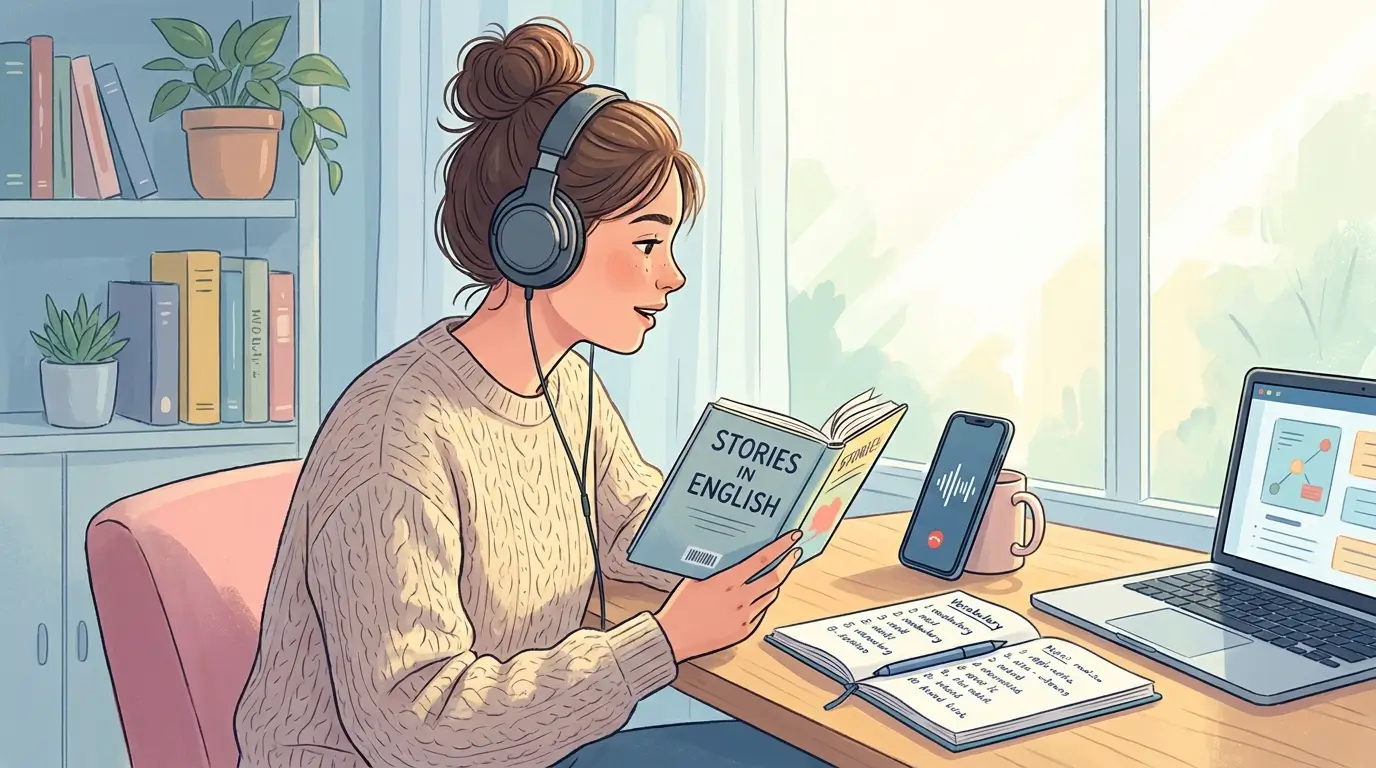
A lot of English learners assume fluency requires actually moving somewhere — London, Toronto, Sydney, wherever people happen to speak it as a first language. Living abroad certainly helps; nobody's arguing otherwise. But it was never really a requirement for becoming a confident speaker.
Real progress is possible from your own living room, provided you build in regular chances to read, listen, speak, write, and generally interact with the language.
The trick isn't cramming five hours into one weekend session. It's letting English become a small, repeated part of an otherwise ordinary week.
Here are ten fairly practical ways to do that without leaving your house.
1. Create an English Environment Around You
Start by folding English into whatever you're already doing.
Switch your phone and computer language to English. Write your shopping list in English. Label a few objects around the house if that sounds useful. Keep a short diary, even a few lines a day. Ordinary tasks turn into practice almost by accident this way.
Instead of thinking "I need to clean the kitchen," try forming the thought in English directly: "I need to clean the kitchen before dinner."
These moments look tiny individually. Stacked over weeks, though, they add up to a fair amount of repeated exposure your brain barely registers as studying.
Listening while commuting, exercising, cooking, or doing chores works the same way — the goal is for English to start feeling like part of the room you're already in, rather than something confined to a textbook you open twice a week.
2. Read Something in English Every Day
Reading might be the easiest independent practice there is. It puts vocabulary, grammar, and sentence structure in front of you inside actual context, which tends to stick better than a word list ever does.
There's no need to start with a difficult novel. Pick something that roughly matches your level, and — this matters more than people expect — something you'd actually want to read anyway: short stories, online articles, blogs, comics, magazines, news sites, social media posts, podcast transcripts, or a simple English-language book.
If every single sentence has an unfamiliar word in it, the material's probably too hard for now. Drop down a level and build up gradually instead.
One habit worth adopting: don't stop to look up every unknown word. Get the general meaning first, then go back for whatever keeps repeating or genuinely blocks understanding.
3. Watch English Movies and TV Shows
Movies and shows turn practice into something you'd do anyway.
If you're just starting out, keep the English subtitles on. As listening improves, try a scene or two without them — understanding every single word was never really the goal.
Repetition helps here specifically. Watch a short scene once for the general idea. Watch it again, this time paying attention to specific vocabulary. Watch it a third time and try repeating a line or two out loud.
Choosing something you've already seen in your own language helps too — knowing the story already frees up attention for the English itself, rather than splitting focus between plot and language.
One caution: don't turn every episode into a grammar lesson. If you're actually enjoying what's on screen, you're considerably more likely to keep watching — which matters more than any single technique.
4. Listen to English Whenever You Can
Listening practice doesn't need its own dedicated hour carved out of the day.
Podcasts, interviews, audiobooks, videos, English-language news — all of it can run alongside things you're already doing: walking, cleaning, exercising, cooking, commuting.
What actually matters is picking something you're genuinely interested in. Listening to content purely because it's "good for your English" tends to get boring fast, and boredom is what kills a habit before it starts.
A simple structure worth trying: first listen for the general idea, second listen for useful words and phrases, third listen for whatever details slipped past the first two times.
Don't worry if full comprehension doesn't arrive right away. Understanding natural, fast, unscripted English is a skill that builds slowly through repeated exposure, not through any single breakthrough listen.
5. Speak English Even When You're Alone
Finding regular speaking practice is probably the hardest part of learning a language without living somewhere it's spoken.
The workaround: you don't strictly need another person for most of it.
Talk to yourself in English. Narrate what you're doing. Explain your plans for the day out loud. Tell yourself a short story. Give an actual opinion about something you just watched or read.
While making breakfast, for instance: "I'm making coffee. I need to leave for work in about thirty minutes, so I'll have breakfast quickly." It'll feel odd for the first while. That's completely normal and tends to fade within a couple of weeks.
Recording yourself is worth doing too. Pick a topic, talk for a minute or two, and don't stop the moment you trip over a word — finish the thought, then listen back afterward.
You'll probably notice a handful of things: a word you keep mispronouncing the same way, a sentence that just sounds off, a moment where the right expression didn't come. Listening back to old recordings weeks later can also be genuinely encouraging — it's one of the clearer ways to actually see your own progress, rather than just feeling vaguely more comfortable.
6. Try an English Audio Diary
An audio diary is a simple way to fold speaking into a daily routine without much friction.
Once a day, record yourself talking for a minute or two about something from your life — what you did today, something interesting you noticed, tomorrow's plans, a problem you worked through, a movie you watched, something you're learning, or your take on whatever's in the news.
Don't write a script beforehand. The entire point is practicing spontaneous, unplanned speech — the kind you'll actually need in a real conversation.
If a word won't come to you in English, don't stall over it. Say it in your first language, finish the recording, look the word up afterward, then try the sentence again with the English version slotted in.
A few weeks in, you'll have a small archive of recordings that lets you actually hear how things have shifted, rather than just guessing.
7. Use English to Explain Things
Here's an exercise that works better than it sounds: teach something you already know how to do.
Pick a hobby, a skill, a subject, an everyday task — anything you're genuinely familiar with — and explain it entirely in English. How to cook your go-to meal. How a sport you play actually works. What your job involves day to day. How to use some piece of software. How to keep a plant alive. The rules of a game you like.
Start with a simple version. Then try a more detailed one covering the parts you skipped the first time.
The exercise forces you to actually hunt for vocabulary and organize your thoughts into something coherent, which is good practice for the moments at work or elsewhere where you'll need to explain something complicated on the spot.
For anyone past the beginner stage, a harder variant: take something genuinely complicated and explain it using only very simple English. That constraint tends to build both clarity and a more flexible vocabulary than the easier version of the exercise does.
8. Keep a Vocabulary and Learning Journal
New words are useful, but a long list scribbled down somewhere rarely sticks on its own.
A small notebook, or a simple document, works better if you record words and phrases you actually run into — not ones pulled from a frequency list, but ones you genuinely encountered somewhere.
For each one: the word itself, its meaning in plain terms, a real example sentence, and maybe a related phrase. "Improve — to become better — 'I want to improve my English speaking skills' — improve your pronunciation," say.
Paying attention to how a word behaves in an actual sentence teaches you more than the definition alone ever will. A learner's dictionary can help fill in pronunciation, example sentences, related word forms, and common collocations if you want to go deeper on any one word.
A separate learning diary is worth keeping too — a weekly goal, what you actually studied, and what gave you trouble. Something like: this week's goal is twenty useful workplace expressions; daily practice is fifteen minutes of vocabulary plus ten minutes of speaking; end-of-week reflection covers which expressions you can actually use naturally now, versus which still feel borrowed.
That kind of record makes progress visible in a way that "I think I'm getting better" never quite does.
9. Use Online Communities and English Resources
The internet puts an enormous amount of English-language material within reach without you leaving the house.
Join an English-learning community, sit in on a discussion forum, find a language exchange partner, or just take part in an online conversation somewhere.
There are also websites built specifically for learners — BBC Learning English, the British Council's learning resources, and EngVid among them — that offer structured lessons rather than just raw content to sift through.
Language exchange works particularly well because it runs both directions: you help someone with your own first language while they hand you real opportunities to use English.
What actually matters is participating rather than just consuming. Reading other people's conversations teaches you something, sure, but writing your own responses is what turns it into active practice instead of passive scrolling.
10. Build a Routine You Can Actually Maintain
The single biggest mistake learners make here is building a study plan that no real week can survive.
Deciding to study three hours every evening sounds ambitious on day one. By day four, work, family, tiredness, or just life in general gets in the way, and the plan quietly dissolves without anyone officially cancelling it.
A smaller routine tends to actually last. Something like: ten minutes with an English podcast in the morning, ten minutes reviewing vocabulary in the afternoon, fifteen minutes reading in the evening, and two minutes recording an audio diary before bed.
That's under forty minutes total, spread across a day that was already happening anyway — and it touches several skills rather than just one.
Consistency beats a perfect schedule, pretty much every time.
Make English Part of Your Life
None of this requires turning your home into a classroom.
It's more about finding where English can naturally slot into a life you're already living — reading about things you actually care about, watching shows you'd watch anyway, listening to a podcast on a walk you were taking regardless, talking to yourself through chores, writing about your own day, connecting with other learners somewhere online.
And it's worth not being precious about mistakes.
A mistake isn't proof you're failing at this. It's proof you're actually using the language, out loud or on the page, instead of just studying it from a safe distance. The more chances you give yourself to use English, awkwardly at first, the less awkward those chances start to feel over time.
A Simple Daily English Plan
If you're not sure where to start, this rough routine works for the next 30 days:
| Activity | Time |
|---|---|
| Listen to English | 10 minutes |
| Read in English | 10 minutes |
| Speak aloud | 10 minutes |
| Review vocabulary | 5 minutes |
| Write a few sentences | 5 minutes |
Fig. 1 — A simple 40-minute daily English routine
There's no obligation to keep this exact shape forever — the point is building the habit itself. After a few weeks, you can raise the difficulty: harder books, faster podcasts, longer speaking sessions, more demanding conversations.
Final Thoughts
Learning English at home is genuinely possible. You might not have an English-speaking street outside your door, but you can build something like that environment inside your own daily routine instead.
What tends to work best is a mix of regular exposure and active practice, cycling through the same five verbs: read, listen, speak, write, review. Then repeat, more or less indefinitely.
You don't need to understand everything the first time through, and you definitely don't need flawless English before you're allowed to start using it.
Start with fifteen or twenty minutes today. Do it again tomorrow. Then the day after that.
Small, repeated efforts like that tend to add up to something considerably larger than any single study session ever could.