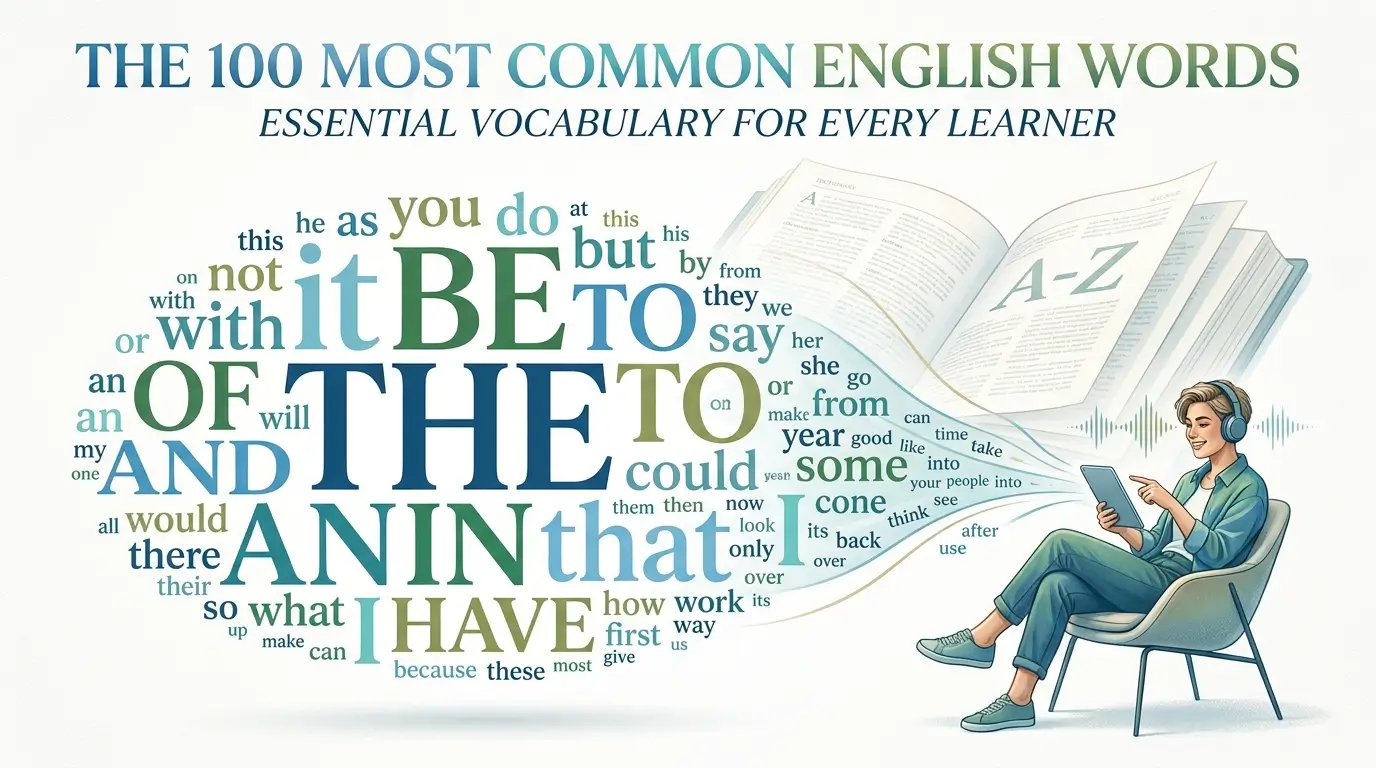
Some words carry meaning. Others just hold the sentence together — and it turns out English leans hard on a small set of the second kind. Below is a ranked list of the 100 most common words in written English, based on data from the billion-word Oxford English Corpus, along with what each word actually does and how to put the list to real use as a learner.
Why Learn the Most Common Words First
Word-frequency research consistently shows something a little surprising: a relatively small number of words account for a huge share of everyday English. Learners who focus on these high-frequency words early tend to reach basic reading comprehension faster than those who start with random vocabulary lists, simply because these words show up again and again — in emails, news articles, conversations, and textbooks alike.
That doesn't mean the other tens of thousands of English words don't matter. It means this particular list is a good place to build a foundation before branching out into more specialized vocabulary for your field or interests.
How This List Was Compiled
The ranking below is based on the Oxford English Corpus, a collection of more than a billion words of real, contemporary English gathered from websites, newspapers, blogs, and books published around the world. Because the corpus draws from global written English rather than a single country or genre, the list leans toward words that are common everywhere English is written — not just in casual speech or a single dialect.
Fig. 1 — Tap any word to hear it pronounced
The 100 Most Common English Words
Here is the complete list, broken into four groups of 25 so it's easier to scan. The "type" column shows the word's most common grammatical role — many of these words can act as more than one part of speech depending on the sentence. Tap the 🔊 button next to any word to hear it read aloud.
Pronunciation uses your browser's built-in text-to-speech, so voice and accent depend on your device. It won't work if your browser doesn't support speech synthesis, or if sound is muted.
Rank 1–25
| Rank | Word | Most Common Type | Listen |
|---|---|---|---|
| 1 | the | article | |
| 2 | be | verb | |
| 3 | to | preposition | |
| 4 | of | preposition | |
| 5 | and | conjunction | |
| 6 | a | article | |
| 7 | in | preposition | |
| 8 | that | conjunction / pronoun | |
| 9 | have | verb | |
| 10 | I | pronoun | |
| 11 | it | pronoun | |
| 12 | for | preposition | |
| 13 | not | adverb | |
| 14 | on | preposition | |
| 15 | with | preposition | |
| 16 | he | pronoun | |
| 17 | as | conjunction | |
| 18 | you | pronoun | |
| 19 | do | verb | |
| 20 | at | preposition | |
| 21 | this | determiner | |
| 22 | but | conjunction | |
| 23 | his | possessive determiner | |
| 24 | by | preposition | |
| 25 | from | preposition |
Rank 26–50
| Rank | Word | Most Common Type | Listen |
|---|---|---|---|
| 26 | they | pronoun | |
| 27 | we | pronoun | |
| 28 | say | verb | |
| 29 | her | pronoun / determiner | |
| 30 | she | pronoun | |
| 31 | or | conjunction | |
| 32 | an | article | |
| 33 | will | modal verb | |
| 34 | my | possessive determiner | |
| 35 | one | number / pronoun | |
| 36 | all | determiner | |
| 37 | would | modal verb | |
| 38 | there | adverb | |
| 39 | their | possessive determiner | |
| 40 | what | pronoun | |
| 41 | so | conjunction / adverb | |
| 42 | up | adverb / preposition | |
| 43 | out | adverb | |
| 44 | if | conjunction | |
| 45 | about | preposition | |
| 46 | who | pronoun | |
| 47 | get | verb | |
| 48 | which | pronoun | |
| 49 | go | verb | |
| 50 | me | pronoun |
Rank 51–75
| Rank | Word | Most Common Type | Listen |
|---|---|---|---|
| 51 | when | conjunction | |
| 52 | make | verb | |
| 53 | can | modal verb | |
| 54 | like | preposition / verb | |
| 55 | time | noun | |
| 56 | no | determiner | |
| 57 | just | adverb | |
| 58 | him | pronoun | |
| 59 | know | verb | |
| 60 | take | verb | |
| 61 | person | noun | |
| 62 | into | preposition | |
| 63 | year | noun | |
| 64 | your | possessive determiner | |
| 65 | good | adjective | |
| 66 | some | determiner | |
| 67 | could | modal verb | |
| 68 | them | pronoun | |
| 69 | see | verb | |
| 70 | other | adjective | |
| 71 | than | conjunction | |
| 72 | then | adverb | |
| 73 | now | adverb | |
| 74 | look | verb | |
| 75 | only | adverb |
Rank 76–100
| Rank | Word | Most Common Type | Listen |
|---|---|---|---|
| 76 | come | verb | |
| 77 | its | possessive determiner | |
| 78 | over | preposition | |
| 79 | think | verb | |
| 80 | also | adverb | |
| 81 | back | adverb / noun | |
| 82 | after | preposition | |
| 83 | use | verb / noun | |
| 84 | two | number | |
| 85 | how | adverb | |
| 86 | our | possessive determiner | |
| 87 | work | noun / verb | |
| 88 | first | adjective | |
| 89 | well | adverb | |
| 90 | way | noun | |
| 91 | even | adverb | |
| 92 | new | adjective | |
| 93 | want | verb | |
| 94 | because | conjunction | |
| 95 | any | determiner | |
| 96 | these | determiner | |
| 97 | give | verb | |
| 98 | day | noun | |
| 99 | most | determiner / adverb | |
| 100 | us | pronoun |
Why Are Most of These "Small" Words?
If you scan the list, you'll notice something: almost none of these are the vivid, image-rich words you'd find in a vocabulary flashcard app. Instead, you get articles (the, a, an), pronouns (I, you, they, it), prepositions (of, in, on, with), and conjunctions (and, but, so, because).
Linguists call these function words — they carry grammatical relationships rather than vivid meaning on their own. Compare that with content words like person, year, work, or good, which appear much less frequently as a category but carry most of a sentence's actual meaning.
How to Actually Learn This List
Simply reading a list of 100 words rarely makes them stick. A few approaches tend to work better:
- Spot them while reading. Pick any short English article and circle or highlight every word from this list that appears. You'll likely find dozens in the first paragraph alone — that repetition is the point.
- Build tiny sentences. Rather than memorizing "of" in isolation, practice full phrases: "a cup of coffee," "one of my friends," "the end of the day."
- Group by function, not by rank. Study all the pronouns together (I, you, he, she, it, we, they, him, her, them, us), then all the prepositions together (of, in, on, at, by, from, with, into, about, over, after). Grouping by category, rather than by numerical rank, tends to be easier to retain.
- Say them out loud in context. Many of these words change pronunciation slightly depending on stress and speed in natural speech (for example, "to" often sounds like "tuh" in fast conversation). Listening practice matters as much as reading practice here.
Practice: Build Sentences With the Top Words
Try writing one short, natural sentence using each pair of words below. There's no single correct answer — just aim for something a native speaker might actually say.
- they / would
- your / good
- could / see
- most / people
- after / work
See example sentences
1. They would probably enjoy this restaurant.
2. Your good habits will help you at work.
3. I could see the mountains from the window.
4. Most people prefer to work in the morning.
5. She usually calls her mother after work.
Final Thoughts
A frequency list like this one isn't a shortcut to fluency, but it is a genuinely efficient starting point. These 100 words won't help you discuss a specific job, hobby, or technical topic — for that, you'll still need vocabulary tailored to your field, which is exactly what our Workplace English and Career Tips sections are for.
But as a base layer underneath everything else you learn, these words are hard to beat. Once they're automatic, reading gets faster, listening gets easier, and there's simply more mental space left over for the words that actually carry your meaning.