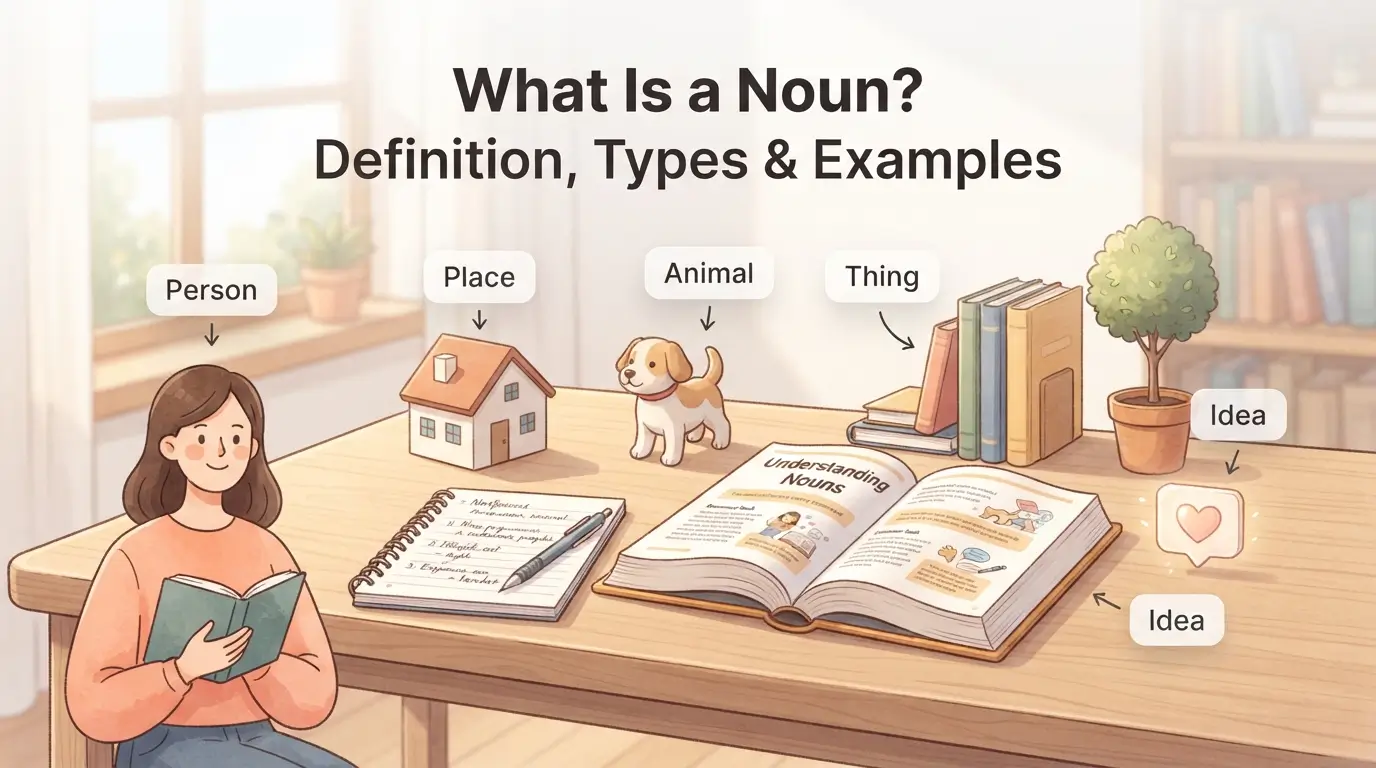
Nouns are one of the most important parts of English grammar. We use them every day when we talk about people, places, objects, animals, feelings, and ideas.
If you are learning English grammar, or teaching it to someone else, understanding nouns is a good place to begin.
What Is a Noun?
A noun is a word used to name a person, place, animal, thing, or idea.
For example:
- Person: teacher, doctor, woman
- Place: school, city, park
- Animal: cat, horse, bird
- Thing: table, phone, book
- Idea: love, freedom, knowledge
Look at this sentence: "The teacher opened the book."
The words teacher and book are nouns because they name a person and a thing.
Nouns can appear in many different positions in a sentence. They can tell us who or what we are talking about, what someone is doing something to, or what something is related to.
Types of Nouns
There are several types of nouns in English. You don't need to memorize them all at once — learning them one at a time makes grammar much easier.
1. Proper Nouns
A proper noun is the specific name of a person, place, organization, or other named entity. Proper nouns normally begin with a capital letter.
Examples: a specific person's name, a specific country, a specific city, a specific day of the week, a specific company name.
Compare: "I live in a city" versus "I live in Dhaka." City is a common noun, while Dhaka is a proper noun.
2. Common Nouns
A common noun gives a general name rather than identifying one particular person, place, or thing.
Examples include: teacher, student, country, city, river, house, computer, restaurant.
For example: "The student opened a book." We don't know which particular student or book — the words simply give general names.
3. Concrete Nouns
A concrete noun names something physical that can be experienced through the senses.
Examples include: apple, chair, dog, tree, house, water, music.
For example: "The dog is sleeping under the table." Both dog and table refer to things that can be physically experienced.
4. Abstract Nouns
An abstract noun names something that is not a physical object. It can describe an idea, feeling, quality, or concept.
Examples include: happiness, honesty, courage, friendship, knowledge, freedom, patience.
For example: "Honesty is an important quality." You cannot physically hold honesty, but you can understand or experience it.
5. Countable Nouns
Countable nouns are things that can be counted individually. They usually have both singular and plural forms.
Examples: one book → two books; one car → three cars; one student → many students.
We can use numbers with countable nouns, as in "I bought three books," and we can also use words such as many, several, a few, and some.
6. Uncountable Nouns
Uncountable nouns usually refer to substances, materials, or ideas that we do not normally count as separate individual units.
Examples include: water, rice, sugar, information, advice, knowledge, furniture.
For example, we say "I need some water," and we don't normally say "two waters" when referring to the substance itself. Instead, we might say two bottles of water.
7. Collective Nouns
A collective noun refers to a group of people, animals, or things.
Examples include: team, family, audience, committee, flock, herd.
For example: "The team won the match." The word team refers to several people but names the group as a single unit.
8. Compound Nouns
A compound noun is made by combining two or more words to create a noun.
Examples include: toothbrush, classroom, bus stop, football, mother-in-law.
Some compound nouns are written as one word, while others are written as separate words or with hyphens — for example, "I left my toothbrush in the bathroom" and "The bus stop is nearby."
9. Possessive Nouns
A possessive noun shows ownership or a relationship between people or things.
Examples: Sarah's book, the dog's collar, my brother's car, the teachers' room.
In these examples, the apostrophe helps show who something belongs to or is associated with — as in "This is John's phone," where the phone belongs to John.

How Nouns Work in Sentences
Nouns can perform different jobs in a sentence.
Noun as the Subject
The subject is the person, animal, thing, or idea doing something or being described.
"The boy plays football." Here, boy is the noun and the subject of the sentence. Another example: "Knowledge is valuable," where knowledge is the subject.
Noun as the Object
A noun can also receive the action of a verb.
"She bought a computer." Here, computer is the object because it receives the action of "bought." Another example: "We watched a movie," where movie is the object.
Noun After a Preposition
Nouns can also come after prepositions such as in, on, at, under, near, and with.
For example: "The keys are on the table," "He works in an office," and "She walked to the park." Here, table, office, and park are nouns following prepositions.
Easy Ways to Identify a Noun
When you are unsure whether a word is a noun, ask a few simple questions.
- Does the word name something? If it names a person, place, animal, thing, idea, or concept, it may be a noun.
- Can it be the subject of a sentence? For example, "Dogs need exercise."
- Can it be the object of a verb? For example, "She reads books."
- Can it follow a determiner? Words such as a, an, the, this, that, my, and some can often come before nouns — "a car," "my friend," "the house," "some information."
These clues can help you recognize nouns when reading or writing.
Noun Examples in Everyday Sentences
Here are some simple examples:
- The teacher explained the lesson.
- My brother bought a new phone.
- We visited the museum on Sunday.
- Friendship takes time to build.
- The children played in the garden.
- She gave me some useful advice.
- The team celebrated after the game.
Notice that nouns can represent very different things, from physical objects such as "phone" and "garden" to abstract concepts such as "friendship" and "advice."
Practice: Find the Nouns
Try identifying the nouns in these sentences before checking the answers.
- "The student opened the window." — Nouns: student, window
- "Sarah visited the library." — Nouns: Sarah, library
- "The dog chased the ball." — Nouns: dog, ball
- "Honesty builds trust." — Nouns: honesty, trust
- "My family visited Dhaka." — Nouns: family, Dhaka
Try creating your own sentences and underlining the nouns. This simple exercise can help reinforce the concept.
Why Are Nouns Important?
Understanding nouns matters because they form a major part of everyday communication. A strong understanding of nouns can help learners:
- Build better sentences
- Expand their vocabulary
- Improve reading comprehension
- Write more clearly
- Understand other parts of speech
- Communicate ideas more effectively
Nouns also provide a foundation for learning more advanced grammar. Once you understand how nouns work, concepts such as pronouns, adjectives, determiners, and noun phrases become easier to follow.
Conclusion
A noun is simply a naming word, but nouns play a much bigger role in English than that simple definition might suggest.
They help us identify the people we know, the places we visit, the things we use, and the ideas and feelings we want to express.
Start by recognizing nouns in everyday sentences. Then gradually learn the major types — proper, common, concrete, abstract, countable, uncountable, collective, compound, and possessive nouns.
The more you notice nouns while reading and speaking, the easier it becomes to use them correctly in your own English.