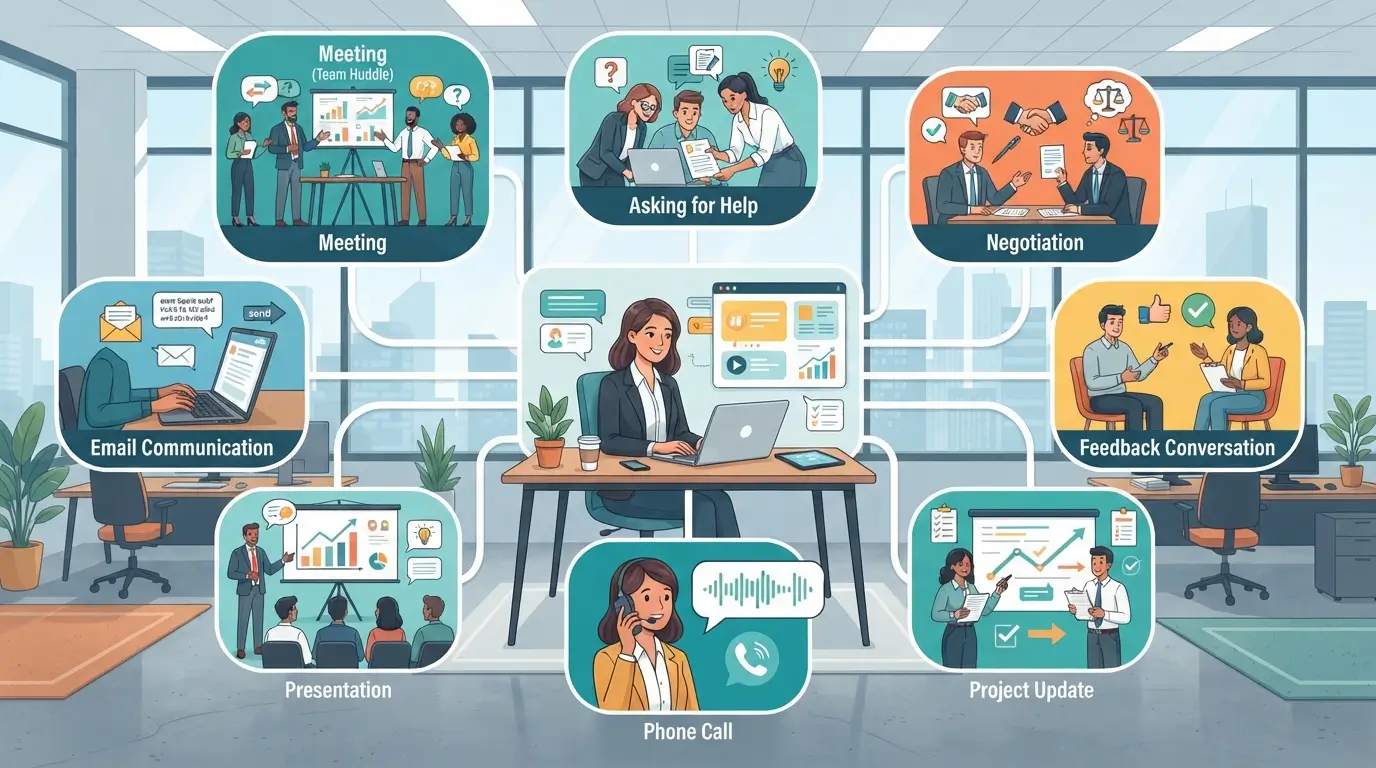
Knowing English grammar is one thing. Using English naturally and professionally at work is genuinely another.
In a meeting you might need to ask for clarification without derailing the whole discussion. In an email you need to make a request that sounds polite rather than demanding. During a presentation you need to signal clearly when you're moving between ideas. Giving feedback, flagging a delay to a client, disagreeing with a colleague without it turning personal — each of these calls for something slightly different.
The reassuring part: none of this requires complicated vocabulary. Clear, natural English tends to work better in most professional situations than impressive-sounding language that's hard to follow.
This guide covers practical professional English expressions across the situations that actually come up at work — meetings, emails, presentations, project updates, phone calls, feedback, and more.
Professional English Expressions for Emails
Email is still one of the most common forms of workplace communication, and a professional one tends to be clear, polite, and direct above everything else.
Starting an Email
"I hope you're doing well."
"I'm writing regarding the meeting scheduled for Thursday."
"Thank you for getting in touch."
"I'm contacting you about the proposal you shared last week."
The opener does one job well: it tells the reader immediately why they've received the email. That matters more than a warm-up sentence.
Making a Polite Request
A direct command works fine with a close colleague. For a client, a manager, or someone less familiar, a polite question tends to land better.
"Could you please send me the updated file?"
"Would you mind checking this document?"
"Would it be possible to move the meeting to Friday?"
"Could you provide some additional information on the timeline?"
Ending an Email
"Please let me know if you have any questions."
"I look forward to hearing from you."
"Thank you for your time."
"Best regards," / "Kind regards,"
The closing mirrors the register of the rest of the message. "Kind regards" fits a formal exchange with a new client; "Thanks" is fine with a colleague you've worked alongside for two years.
Professional English Expressions for Meetings
Meetings ask you to listen, respond, contribute ideas, and sometimes steer the discussion — often all within the same fifteen minutes. A few reliable phrases make that considerably easier.
Starting a Meeting
"Shall we get started?"
"Thank you everyone for joining. Today, I'd like to discuss our plans for the next quarter."
"Let's start by looking at the main points."
Joining the Discussion
"I'd like to add something — we should also consider the cost of implementation."
"Could I make a suggestion?"
"From my perspective, the timeline looks tight."
"There's one point I'd like to mention."
Asking for Clarification
Asking when something's unclear beats pretending to understand and misapplying it for the next week.
"Could you clarify that point?"
"Could you give us an example of what that looks like in practice?"
"I'm not sure I follow — could you expand on that?"
"Could you repeat that, please?"
Keeping a Meeting on Track
"Could we come back to the main issue?"
"Perhaps we can save that for a separate conversation."
"Can we move on to the next point?"
Professional English Expressions for Agreeing
Simply saying "Yes" technically communicates agreement. In a workplace discussion, though, adding a reason or building on the idea tends to show you're actually engaged rather than just nodding along.
"I agree." "That makes sense." "That's a good point." "I feel the same way."
"I agree with that approach. We could also ask the sales team for their input."
"That's a good point. We should also consider the budget implications."
"I think that makes sense. Another option worth considering would be..."
Professional English Expressions for Disagreeing
Disagreement is a normal part of work. The challenge is expressing a different opinion without making the conversation personal.
"That's wrong" closes a conversation down. "I see your point, but I have a slightly different perspective" keeps it open.
"I see it differently."
"I'm not entirely convinced."
"I understand your point, but I have some concerns about the timeline."
"I understand why you suggested this. My concern is that it could increase the workload for the team."
Acknowledging the other person's reasoning before explaining the concern tends to keep the exchange collaborative rather than adversarial.
Professional English Expressions for Presentations
Presentations become considerably easier to follow when the speaker signals clearly what's happening — moving to a new point, referring to a slide, wrapping up a section.
Introducing a Presentation
"There are three main areas I'd like to cover today: our current results, the challenges we face, and our plans for next month."
"I'd like to begin with a quick overview."
"Let's start by looking at what the data actually shows."
Referring to Information
"As you can see here..." "If we look at this chart..."
"The main point to notice is..." "Let me give you a concrete example."
Moving Between Topics
"Let's move on to..." "That brings me to my next point."
"Now let's look at what this means in practice."
Closing
"To summarize the key points..." "In short..."
"That brings me to the end of my presentation. Thank you for listening. I'd be happy to answer any questions."
Professional English Expressions for Giving Feedback
Feedback lands better when it's balanced — naming what worked before explaining what could change. That isn't just politeness; it gives the other person context for why the improvement matters.
"I appreciate the effort you put into this."
"The presentation was clear overall — the structure worked well."
"You handled the client questions confidently."
"One area we could improve is the amount of detail on the final slide."
"It might be helpful to include a couple more examples in the report."
"Perhaps we could tighten the executive summary — it's currently running a bit long."
Professional English Expressions for Project Updates
A good update tells people three things: where things stand, what the problem is if there is one, and what happens next. The rest is usually detail that could've stayed in an email.
"We've completed the research stage and are currently preparing the first draft."
"The project is progressing as planned — we're on track for the deadline."
"We're currently working on the testing phase."
"The main challenge at the moment is the delay in receiving the data from the client."
"We've run into an issue with the API integration."
"There's been a delay — we may need two additional days."
"Next, we'll complete the analysis and prepare the report."
"I'll follow up once we have the final numbers."
"We plan to review the results before presenting to the client."
Professional English Expressions for Phone Calls
Phone conversations strip out the visual cues — no facial expression, no body language, no shared document on a screen. Clear, predictable language helps considerably.
"Hello, this is Ahmed from the sales department. I'm calling regarding the order we discussed yesterday."
"Is now a good time to talk?" "Am I catching you at a convenient moment?"
"Could you repeat that, please?" "Sorry, I didn't catch that."
"Could you speak a little more slowly?" "Would you mind saying that again?"
"I'll follow up by email with the details."
"Thank you for your time — it was good speaking with you."
"I'll be in touch soon."
Professional English Expressions for Networking
Professional relationships tend to start with a fairly ordinary conversation rather than anything elaborate. The goal is genuine engagement, not a sales pitch in disguise.
"It's nice to meet you." "It's great to connect."
"What kind of work do you specialize in?"
"I'd be interested to hear more about what your team is working on."
"It was great talking with you. Let's stay in touch."
"Would you be interested in connecting on LinkedIn?"
Professional English Expressions for Negotiations
Negotiation language tends to keep doors open rather than forcing a yes or no too early.
"Could we find a middle ground on the timeline?"
"That price would be difficult for us. Could we discuss a different payment schedule?"
"Would you be willing to consider a phased delivery?"
"Perhaps we could compromise on the scope of the first release."
"That's outside our current budget — could we revisit that point?"
Professional English Expressions for Asking for Help
Asking for assistance is a normal part of any workday, and phrasing it as a question rather than a statement tends to make it easier for the other person to respond naturally.
"Could you help me with this client request?"
"Would you mind taking a look at this before I send it?"
"Could I get your advice on the best approach here?"
"Do you have a few minutes to talk through this?"
Professional English Expressions for Handling Problems
When something goes wrong at work, the language worth reaching for tends to be calm and forward-looking — what's happening, what's being done about it, and what comes next.
"There seems to be a problem with the payment system. We're looking into it and I'll keep you updated."
"We've identified an issue with the data export — we're working on a fix."
"We'll let you know as soon as we have more information."
Professional English Expressions for Closing a Discussion
Ending a meeting or conversation well means making sure everyone actually leaves knowing what happens next — who does what, by when.
"Just to confirm — Sarah will prepare the report and John will review it by Friday."
"Let's summarize the key points before we wrap up."
"What are the next steps, and who's responsible for each?"
"Is there anything else we need to discuss today?"
How to Learn Professional English Expressions
Memorizing dozens of phrases at once tends to produce exactly nothing useful. A more practical approach is learning expressions that match the situations you actually face most often.
Learn Phrases by Situation
Rather than random vocabulary, grouping expressions by context — meetings, emails, phone calls, feedback, project updates — makes them considerably easier to retrieve when a situation actually calls for them.
Learn Complete Expressions, Not Single Words
Knowing the word "clarify" is less useful than knowing "Could you clarify that point?" — the complete structure is what gets retrieved mid-conversation, not the bare word.
Create Personal Examples
"I'll follow up by email" sticks better once it's attached to a real situation from your own work rather than a sentence from a textbook.
Practice Speaking Aloud
Reading a phrase silently is a genuinely different skill from saying it in real time. Speaking expressions aloud, at different speeds and with natural pauses, tends to reveal which ones still feel unfamiliar in the mouth.
Avoid Overloading Sentences
Professional English doesn't mean packing every sentence with formal vocabulary. "I think we should discuss this again next week" is clear, appropriate, and works perfectly well. Complicated language for its own sake rarely helps communication.
Common Mistakes When Using Professional English
Assuming Longer Words Sound More Professional
They don't. "Could you send me the report?" is clear and entirely professional. Adding unnecessary words rarely makes a request sound better — it often just makes it harder to follow.
Memorizing Phrases Without Understanding Context
A phrase might be grammatically correct and still wrong for the situation. Worth asking before using anything: who's the recipient, is the relationship established or new, is this a request or a disagreement, is the tone formal or fairly relaxed?
Relying on the Same Phrase Repeatedly
Using "I think" or "Could you..." in every sentence makes the language feel mechanical. Building a small collection of alternatives — and actually choosing between them — is what natural professional communication actually looks like.
Frequently Asked Questions
What are professional English expressions?
Professional English expressions are commonly used phrases that help people communicate clearly and appropriately in workplace situations — meetings, emails, presentations, phone calls, feedback conversations, and project updates.
What are some useful English expressions for work?
"Could you clarify that point?" "I'd like to add something." "I'll follow up by email." "Let's summarize the key points." "I have a slightly different perspective." These cover a wide range of everyday professional situations.
How can I improve my professional English?
Practice expressions tied to real workplace situations, build your own examples, say them aloud, and bring them gradually into actual emails, meetings, and conversations rather than studying them in isolation.
Should professional English always be formal?
No. Professional English should match the situation. A conversation with a close colleague can reasonably be more relaxed than an email to a new client or a formal presentation to senior leadership.
How can I sound more confident in English at work?
Clear sentences, minimal unnecessary words, and genuine familiarity with the language needed for the specific situation tend to matter more than anything else. Confidence tends to build as the language becomes more automatic rather than something that has to be consciously assembled.
Clear Language, Confidently Delivered
Professional English was never really about using difficult words or sounding like a formal document.
It's about communicating ideas clearly, respectfully, and with enough confidence that the message actually lands. Whether that's an email, a meeting contribution, a presentation, a client call, or a difficult conversation with a colleague — having a handful of reliable expressions ready tends to make each of those situations considerably less demanding.
Start with the situations that come up most often in your actual work. Pick five or ten expressions that fit, practice them in your own sentences, and bring them into real communication rather than leaving them in a notebook. With enough use, they tend to stop feeling like something retrieved and start feeling like something you just say.