You can write a flawless email and still freeze the moment a colleague turns and asks, "So, what do you think?"
That's the moment where workplace English stops being about grammar and vocabulary and starts being about something harder to study for.
Joining a meeting, checking in with a manager, making small talk with a coworker, talking through a problem with a client, explaining what you actually did that day — all of it requires responding on the spot and keeping a conversation moving forward, not just understanding it.
For a lot of professionals, that's genuinely the hardest part of learning English. Written English might come fairly easily. Real-time conversation, with no time to draft and revise, tends to feel like a different skill entirely.
The reassuring part: none of this requires memorizing hundreds of complicated expressions. It requires regular practice with the situations that actually come up at work.
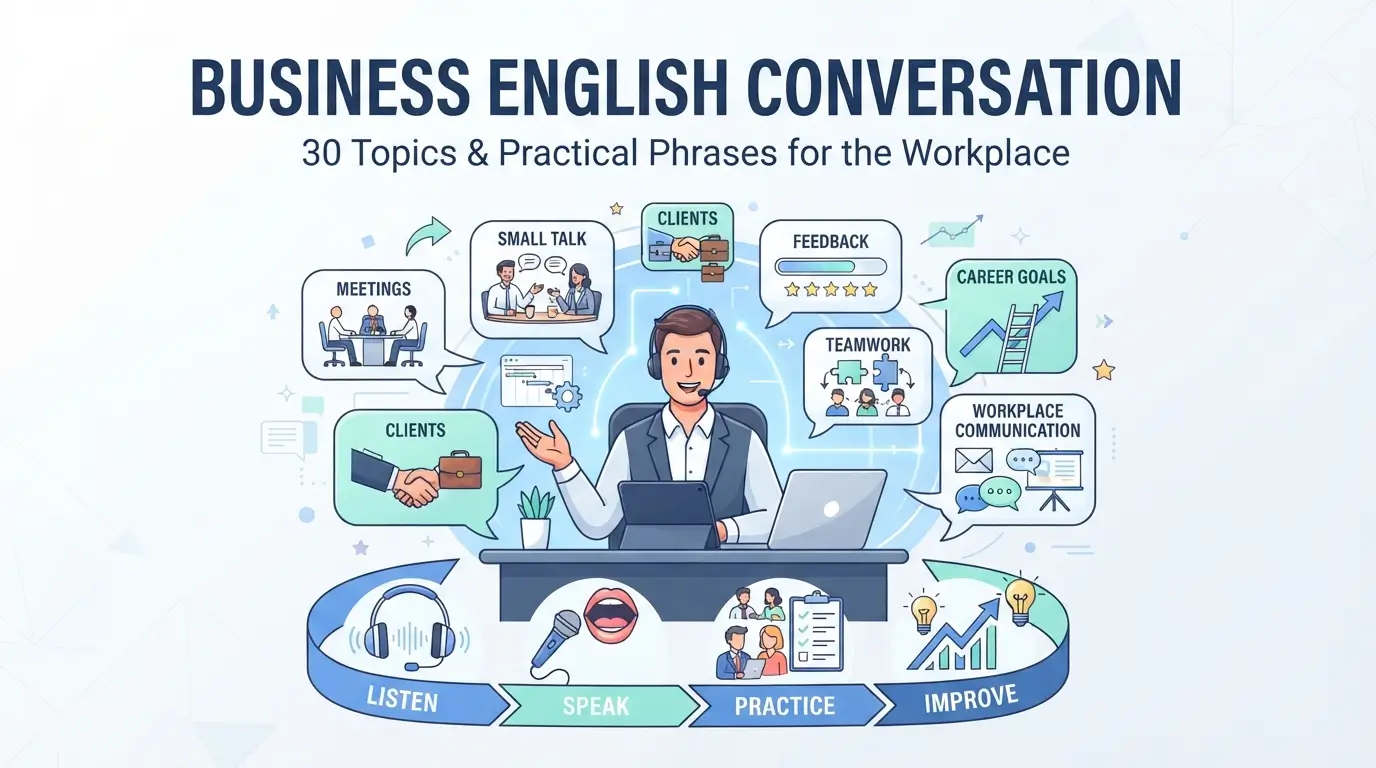
This guide covers 30 business English conversation topics, a set of genuinely useful phrases, and some practical ways to build real speaking confidence.
Why Business English Conversation Skills Matter
Workplace communication rarely stays confined to formal presentations or written reports. A large share of professional life just happens through ordinary conversation.
Discussing a project over coffee. Explaining a problem to a colleague. Trading ideas mid-meeting. Making small talk before a video call actually starts. All of that is business English conversation, whether or not anyone labels it that way.
Strong conversation skills tend to help with explaining ideas more clearly, participating in meetings with actual confidence, building better relationships with coworkers, asking a question without the discomfort that sometimes comes with it, giving and receiving feedback, handling a client conversation, working through a problem out loud, making professional small talk, following different speaking styles and accents, and expressing an opinion without it landing wrong.
None of this requires flawless English either. In plenty of workplace situations, clarity, confidence, actual listening, and an appropriate tone matter more than vocabulary sophistication ever will.
The goal was never sounding like a textbook. It's communicating naturally, and professionally, at the same time.
Useful Business English Phrases for Workplace Conversations
Before getting into specific topics, a handful of ready-made expressions are worth having on hand across different situations.
Greeting and small talk: "Good morning. How are you doing today?" "How was your weekend?" "Did you have a good trip?" "How is everything going?" "It's nice to meet you." "I'm looking forward to working with you."
Making requests: "Could you send me the latest version when you have a chance?" "Would you mind checking this for me?" "Could you give me an update on the project?" "Would it be possible to move the meeting to tomorrow?" "Please let me know if you need any help."
Discussing projects: "What's the current status of the project?" "Are we still on track for the deadline?" "Which task should we prioritize?" "Let's discuss the next steps." "There seems to be a problem with the current approach." "What do you think would be the best solution?"
Giving opinions: "I think we should consider another option." "From my perspective, this could work." "I see your point, but I have a slightly different view." "That's a good suggestion." "Could you explain what you mean by that?"
Giving feedback: "You handled that presentation really well." "I think the report is clear and well organized." "One thing we could improve is the amount of detail." "I appreciate the work you put into this." "Maybe we could approach this differently next time."
Phone calls and emails: "How can I help you today?" "Could you repeat that, please?" "Let me check and get back to you." "I'll send you the information shortly." "I've attached the document for your reference." "I look forward to hearing from you."
30 Business English Conversation Topics to Practice
One of the more efficient ways to improve spoken English is practicing around topics you'll actually run into, rather than studying vocabulary at random. Pick a workplace situation and talk about it out loud for a few minutes — that alone tends to teach more than a vocabulary list ever will.
Here are thirty, grouped into four rough clusters.
Your Job and Workplace
1. Your Job Role — Talking about your own job is some of the most immediately useful workplace English there is. Try: "What do you do in your current role?" A workable answer: "I work in marketing, and I mainly look after our digital campaigns and social media content."
2. Your Typical Workday — Describe an ordinary working day — start time, meetings, recurring tasks, breaks, how the day gets organized. Try: "What does a typical day at work look like for you?" This is a good one for practicing "usually," "normally," "often," and "sometimes."
3. Your Workplace — Describe your office, or your home setup, or wherever you actually work — the layout, the atmosphere, the facilities, what kind of environment you actually work best in. Try: "What's your workspace like?" or "Do you prefer working in a busy office or a quiet environment?"
4. Remote and Hybrid Work — Plenty to discuss here: video meetings, communication tools, flexibility, productivity, and the genuine challenges of working from home. Try: "Do you prefer working remotely or from the office?"
5. Your Team — Explain how your team's actually organized — size, responsibilities, how communication flows. Try: "How is your team structured?"
6. Company Departments — Practice talking about sales, marketing, finance, HR, IT, customer service. "I work closely with the sales team because we need to coordinate our campaigns" is the kind of sentence that builds vocabulary useful across an entire company, not just your own corner of it.
7. Office Technology — Software, communication platforms, hardware, technical hiccups. Try: "Which tools do you use most often at work?" And practice explaining a problem cleanly: "I'm having trouble accessing the shared folder."
8. Office Rules and Policies — Working hours, dress code, attendance, meeting etiquette, remote-work policy — genuinely useful in an international workplace. Example: "Our company has a flexible working policy. Employees can work from home twice a week."
Commuting and Travel
9. Your Daily Commute — How you get to work, how long it takes, the traffic, the delays. Try: "How long does it usually take you to get to work?"
10. Public Transportation — Buses, trains, reliability, cost, delay. Try: "How reliable is public transportation in your area?"
11. Driving to Work — Traffic, parking, fuel, the trade-offs of commuting by car. "Traffic is usually heavy on Monday mornings, so I try to leave early" is a solid, natural example.
12. Carpooling With Colleagues — Good for practicing a suggestion and some polite negotiation. Try: "Would you ever consider sharing a ride with a colleague?" and talk through schedules, cost, and convenience.
13. Working Without a Commute — Flexibility and work-life balance, minus the drive or train ride. Try: "How has working from home changed your daily routine?"
14. Transport Delays — Late trains, traffic jams, canceled buses — genuinely common. Practice explaining lateness: "I'm sorry I'm late. There was a major delay on the train this morning." Worth rehearsing since it's a real situation you'll actually need.
15. Business Travel — Trips, conferences, flights, hotels, schedules. Try: "Have you ever traveled for work?" and practice explaining how you'd organize one.
Casual and Social Conversation
16. Hobbies — Personal interests tend to be easier terrain than technical work topics, and they build vocabulary for preference and experience. Try: "What do you like doing outside work?"
17. Lunch and Coffee — Casual, low-stakes practice: "Would you like to grab some lunch?" "Do you want to get a coffee?" Small exchanges like these add up faster than they seem to.
18. Weekend Plans — Classic small talk, and a chance to practice "I'm going to," "I'm planning to," and "I might." Try: "Do you have any plans for the weekend?"
19. Holidays and Cultural Traditions — International workplaces mix backgrounds constantly, and holidays are a natural way to talk about it. Example: "In my country, we usually celebrate this holiday with family and traditional food."
20. Work Anniversaries — A colleague hitting a milestone is an easy conversation opener. "Congratulations on your work anniversary!" "How long have you been with the company?"
21. Small Talk Before a Meeting — Not every conversation needs to launch straight into business. "How's your morning going?" or "Have you had a busy day so far?" tend to ease everyone in.
22. Weather — Simple on the surface, genuinely useful for spontaneous conversation. "It's been unusually hot this week, hasn't it?" The value isn't the topic — it's practicing a natural response and a follow-up question.
23. Current Events — Useful, especially tied to your own industry, though worth choosing carefully in a professional setting — neutral ground tends to be safer than politics or anything too personal. Try: "Have you seen the recent news about the industry?"
24. Movies and TV Shows — An easy way to connect with a coworker. "Have you watched anything good recently?" opens the door to describing what did or didn't land for you.
25. Books and Podcasts — Good for practicing actual opinions, not just facts. "I recently listened to a podcast about leadership. One of the ideas really caught my attention" is the kind of sentence worth building toward.
26. Team Events — Lunches, celebrations, workshops, conferences. Before: "Are you going to the team event on Friday?" After: "It was nice getting to know everyone outside the office."
Professional and Strategic Conversation
27. Company Goals — This one shifts from casual into more genuinely professional English — objectives, upcoming projects, priorities. Try: "What are the team's main priorities this quarter?"
28. Workplace Challenges — Being able to discuss a real problem, without it turning into a complaint, is a genuinely useful skill on its own. Instead of "Everything is going wrong," try "We've had a few problems with the current process. I think we should look at some alternatives."
29. Giving and Receiving Feedback — Feedback conversations need some care with language — naming what worked before naming what didn't. "The presentation was clear and well organized. One area we could improve is the amount of information on the final slide." And on the receiving end: "Thanks for pointing that out. I'll keep it in mind for the next presentation."
30. Career Goals — Skills you want to build, future responsibilities, training, where you're actually trying to go. Try: "What skills would you like to develop over the next few years?"
How to Improve Your Business English Conversation Skills
Knowing the topics is useful. It will not turn anyone into a confident speaker on its own — passive knowledge needs converting into actual speaking ability.
Practice One Workplace Topic at a Time
Pick one topic rather than trying to absorb everything at once. Monday might be job responsibilities. Tuesday, a typical workday. Later in the week, meetings or workplace problems. Speak for two or three minutes without reading from a script — if a word gets stuck, note it and look it up afterward instead of stopping mid-thought.
Use Role-Play
Role-play gives speaking practice an actual purpose. Imagine asking your manager for more time, explaining a delay, welcoming a new colleague, talking with a customer, joining a meeting, giving feedback, asking for clarification, or making a suggestion. Prepare one opening sentence for each, then just keep talking naturally from there.
Follow the 70/30 Principle
Practicing with another person, aim to spend more time actually speaking than explaining — something like 70% speaking, 30% listening. Not a strict rule, just a rough target that keeps the practice weighted toward the skill that's actually hardest to build. Listening still matters — it's where natural vocabulary, pronunciation, rhythm, and alternate phrasing come from.
Record Yourself
A phone turns into a surprisingly effective practice tool here. Pick a question — "What are your main responsibilities?" — and answer it out loud for two minutes. Then listen back and ask: did that sound clear? Did the same words keep repeating? Were there too many pauses? Was the pronunciation actually understandable? Did the ideas follow some logical order? Could any phrase have landed more naturally? Fixing one or two things per recording beats trying to fix everything at once.
Learn Phrases, Not Just Individual Words
Isolated vocabulary makes speaking harder than it needs to be. Knowing "deadline" helps; knowing "We need to meet the deadline," "Are we still on track for the deadline?", "We may need to extend the deadline," and "Can we agree on a realistic deadline?" helps considerably more, since the phrase is what actually gets retrieved mid-conversation.
Listen to Professional English
Business podcasts, interviews, webinars, workplace videos — none of it requires understanding every word. Worth noticing instead: how speakers open a conversation, explain an idea, disagree without friction, ask a question, shift topics, summarize, and close things out. Pick a few expressions from what you hear and practice saying them aloud.
Use English During Your Actual Workday
No need to wait for a formal lesson. Write a task list in English. Take meeting notes in English. Narrate the next task to yourself in English. Use English with colleagues where it's appropriate. Small, daily amounts of this tend to beat one long study session a week by a wide margin.
Common Problems When Speaking English at Work
"I Know the Words, but I Can't Speak Quickly"
This usually traces back to translating a full sentence internally before saying anything out loud. Practicing common phrases until they're automatic — rather than translating each one fresh — tends to fix it. "Let me think about that." "That's a good point." "Could you clarify what you mean?" "I'll check and get back to you." These buy thinking time while the conversation keeps moving.
"I'm Afraid of Making Mistakes"
Mistakes are unavoidable in a second language, and that's fine. Focusing so hard on grammar that speaking itself gets avoided tends to reduce the very practice that would fix the grammar. Clear communication first; accuracy tends to improve gradually through feedback and repetition, not through waiting until it's already correct.
"I Don't Know What to Say"
Which is really why conversation topics exist. A handful of reliable questions covers more ground than memorizing entire conversations ever could. Meeting a new colleague, for instance: "How long have you been working here?" "What team are you part of?" "What kind of projects do you usually work on?" "How are you finding the company so far?" A few dependable questions make starting a conversation considerably less daunting.
"I Struggle With Different Accents"
International workplaces bring in speakers from plenty of different backgrounds, and training your ear on only one accent leaves you unprepared for the rest. Listening across regions and speaking styles, even when some accents feel genuinely hard to follow at first, tends to widen what your ear can actually process over time.
A Simple 15-Minute Business English Practice Routine
None of this requires hours of study.
Fig. 1 — A simple 15-minute business English practice routine
Minutes 1–3: five workplace words or phrases. Minutes 4–7: a short professional conversation, interview, or business clip. Minutes 8–12: one workplace topic, spoken about without reading. Minutes 13–15: two mistakes, missing words, or awkward phrases noted down, then practiced again.
Doing this regularly tends to turn English from something studied into something actually used.
Frequently Asked Questions
What is business English conversation?
Business English conversation refers to spoken English used in professional situations — meetings, workplace small talk, client communication, presentations, discussions, and everyday conversations with colleagues.
How can I improve my English conversations at work?
Practicing realistic workplace situations regularly tends to matter more than any single technique. Focus on common phrases, listen to professional English, record yourself speaking, and use English during appropriate parts of your actual workday.
What are good business English conversation topics?
Useful ones include job responsibilities, daily routines, projects, meetings, remote work, workplace technology, commuting, hobbies, weekend plans, company goals, feedback, and career development.
How can I become more confident speaking English at work?
Starting with short conversations about familiar subjects tends to help. Prepare a few useful expressions and questions, practice regularly, and accept that mistakes are part of the process — confidence usually builds through repeated use rather than memorization alone.
Should I learn individual business English words or phrases?
Phrases and word combinations tend to be more practical for actual conversation. Rather than memorizing just "deadline," learning "meet the deadline," "extend the deadline," and "are we still on track for the deadline?" tends to serve you better mid-conversation.
How much should I practice English speaking every day?
Even 10 to 15 minutes of focused practice, done consistently, tends to be useful. The regularity of the practice matters more than occasionally studying for long stretches.
Speaking Is Part of How You Get Better
Good workplace communication was never really about having the biggest vocabulary or a flawless accent.
It's about joining a conversation, getting an idea across, asking a genuinely useful question, listening properly, and responding in a way that fits the moment. That ability builds through practice, and really only through practice.
Start with familiar ground — your job, your team, your commute, a hobby, the weekend. Then work gradually toward harder territory: feedback, workplace problems, negotiation, presenting an actual idea.
The more these conversations get practiced in something close to their real form, the less translation happens in your head, and the more naturally a response tends to arrive when it's actually needed.
There's no need to wait until your English feels finished before speaking it. Speaking is part of how it gets better in the first place.