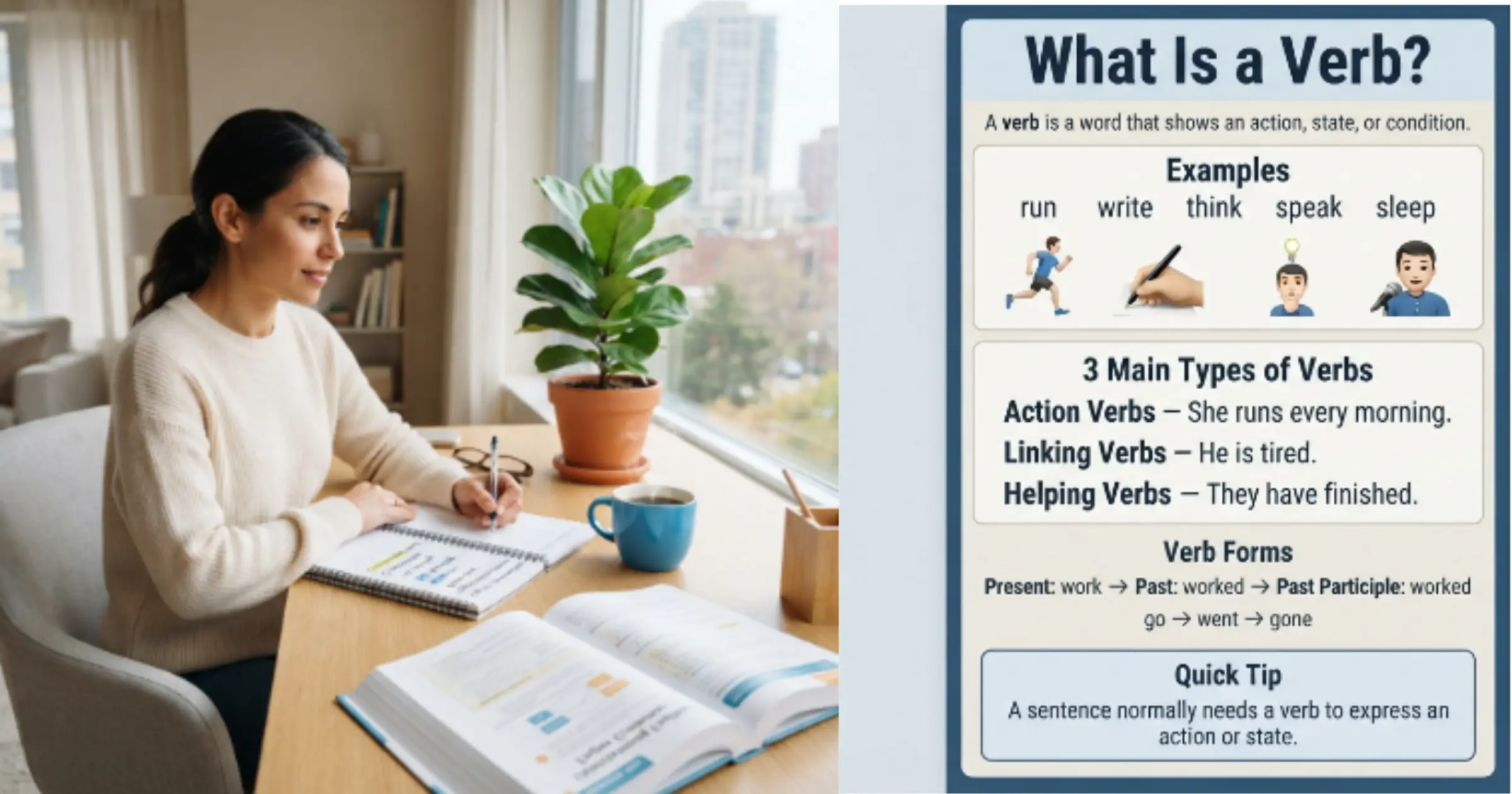
Verbs are what make sentences work.
When we say "She works at a bank," "They were waiting for the bus," or "I have finished my homework," the verbs tell us what is happening, when it happens, or what state something is in.
For English learners, verbs can also be one of the more confusing parts of grammar. A verb can change according to tense, subject, or meaning. Some verbs describe actions, while others connect a subject to a description. Some need an object; others do not.
The good news is that you don't need to learn everything at once. This guide covers the main types of English verbs, how they change form, how they work in sentences, and a few common mistakes worth watching for.
What Is a Verb?
A verb is a word that expresses an action, occurrence, or state.
Consider these examples: Maria works in a hospital. The children played outside. I believe you. The soup tastes good. They are tired.
The verbs here are works, played, believe, tastes, and are. Notice that not all verbs describe physical movement — believe describes a mental state, while are connects the subject with a description.
Verbs in Everyday Sentences
| Sentence | Verb | What It Expresses |
|---|---|---|
| David runs every morning. | runs | Physical action |
| I remember her name. | remember | Mental activity |
| She likes classical music. | likes | Feeling or preference |
| The keys are on the table. | are | State or condition |
| Please sit here. | sit | Command |
A complete English sentence normally contains a verb. An imperative such as "Stop!" is a useful exception to the usual subject-verb pattern, because the subject you is simply understood rather than stated.
Fig. 1 — The four core verb types at a glance
Main Types of Verbs
There are several ways to classify English verbs, and the categories sometimes overlap — which is why different grammar books can appear to give different lists. The most useful starting point is to understand action verbs, linking verbs, and helping verbs.
1. Action Verbs
An action verb describes something a person, animal, or thing does.
Some actions are physical: run, open, write, cook, drive, swim. Others describe mental activities: think, remember, understand, believe, imagine.
For example: "Daniel opened the window" describes a physical action, while "I remember that conversation" describes a mental process.
Transitive and Intransitive Verbs
Action verbs can also be classified by whether they take a direct object.
A transitive verb is followed by a direct object: "She wrote a letter." Ask, "What did she write?" The answer is a letter.
An intransitive verb does not take a direct object: "The baby cried." There is no direct object after cried.
Some verbs work both ways depending on the sentence. In "She sang a song," sang has a direct object — a song. In "She sang beautifully," it does not. This distinction becomes useful once you start studying sentence structure more closely.
2. Linking Verbs
A linking verb connects the subject with information that describes or identifies it.
The verb be is the most familiar linking verb: "The room is quiet." Here, is does not describe an action — it links the room with the adjective quiet.
Other verbs can also function as linking verbs: seem, become, appear, remain, feel, look, sound, taste, smell.
Examples: "She seems nervous." "The weather became colder." "The soup tastes delicious." "He remained calm." The word or phrase after the linking verb tells us something about the subject.
Be Careful With Verbs Such as "Feel" and "Look"
Some verbs can function as either linking or action verbs, depending on context.
Compare "The fabric feels soft" — here feels connects the fabric with the description soft, so it's a linking verb — with "She felt the fabric," where felt describes an action performed by she, making it an action verb. Context determines the function.
3. Helping Verbs
Helping verbs, also called auxiliary verbs, work with a main verb to express things such as tense, questions, negatives, possibility, or emphasis. The three primary helping verbs are be, have, and do.
Be — forms of be are used in continuous and passive constructions: "She is studying." "The window was broken."
Have — forms of have create perfect constructions: "They have finished the project." "He had already left when I arrived."
Do — forms of do are commonly used in questions, negatives, and emphasis: "Do you like coffee?" "I do not understand." "I do want to help."
Helping verbs can seem confusing at first because the same word can sometimes function as a main verb. Compare "I have a car" (here, have is the main verb) with "I have finished my work" (here, have is helping the main verb finished).
Modal Verbs
Modal verbs are a special group of auxiliary verbs. They can express ability, possibility, permission, advice, prediction, or necessity.
Common modal verbs include: can, could, may, might, will, would, shall, should, must.
Examples: "I can swim." "It might rain tonight." "You should call your doctor." "We must leave now."
Understanding Verb Forms
English verbs change form in different situations. Take the verb work: work, works, worked, working. An irregular verb such as go behaves differently: go, goes, went, gone, going. Understanding these forms is essential for building accurate sentences.
Subject-Verb Agreement
In the present simple tense, the verb usually changes when the subject is he, she, or it.
Compare: "I work from home." "They work from home." But: "She works from home." "My brother works at a bank." This small -s causes a surprising number of mistakes for English learners.
✗ She work every day. → ✓ She works every day.
✗ He like coffee. → ✓ He likes coffee.
✗ They likes coffee. → ✓ They like coffee.
A useful habit is to check the subject before choosing the verb form.
English Verb Tenses
English has three basic time references — present, past, and future — expressed through simple, continuous, perfect, and perfect continuous forms. Here's a quick overview using the verb study:
| Time | Simple | Continuous | Perfect | Perfect Continuous |
|---|---|---|---|---|
| Present | I study | I am studying | I have studied | I have been studying |
| Past | I studied | I was studying | I had studied | I had been studying |
| Future | I will study | I will be studying | I will have studied | I will have been studying |
These forms do more than locate an action in time — they can also show whether an action is complete, ongoing, repeated, or connected to another event.
Fig. 2 — Past, present, and future using the verb "work"
Present Tenses
Present Simple
The present simple is commonly used for habits, routines, facts, and situations that are generally true: "I drink coffee every morning." "She works at a hospital." "Water boils at 100°C at standard atmospheric pressure."
Negative: "She doesn't work on Sundays." Question: "Does she work on Sundays?" Remember that after does, the main verb returns to its base form — "Does she work?" not "Does she works?"
Present Continuous
The present continuous is formed with am, is, or are plus the -ing form of the verb. It commonly describes something happening now or around the present period: "I am reading a new book." "They are working on a project."
It can also describe a temporary situation — "She is staying with her parents this month" — and it's often used for planned future arrangements: "We are meeting the client tomorrow."
Present Perfect
The present perfect combines have/has with a past participle. It's often used when a past event has a connection with the present: "I have finished my report." "She has visited London twice."
It can also describe an experience — "We have never tried sushi" — or an action that started in the past and continues to the present: "He has lived here for five years." The exact meaning depends on context, so the present perfect can't always be reduced to one simple rule.
Past Tenses
Past Simple
The past simple describes completed events in the past: "I watched a movie last night." "She visited her parents on Saturday." Regular verbs usually take -ed, although many common verbs are irregular — "walk" becomes "walked," but "go" becomes "went."
Negative: "She didn't watch the movie." Question: "Did she watch the movie?" After did, we use the base form — "Did she watch?" not "Did she watched?"
Past Continuous
The past continuous uses was/were + verb-ing. It describes an action that was in progress at a particular time in the past: "I was sleeping when the phone rang." "They were having dinner at 8 p.m." It's particularly useful when one past action interrupts another: "I was driving home when it started to rain."
Past Perfect
The past perfect uses had + past participle. It can show that one past event happened before another: "I had finished dinner before they arrived." First, dinner was finished. Then, they arrived. The past perfect makes that sequence clear.
Future Forms
English expresses future meaning in several ways. One of the most common is will + base verb.
Future Simple
"I will call you tonight." "She will probably arrive later." It's used for predictions, promises, decisions made at the moment of speaking, and other future situations. Negative: "I will not forget" or "I won't forget." Question: "Will you call me later?"
Future Continuous
The future continuous uses will + be + verb-ing, describing something in progress at a particular future time: "At 9 p.m., I will be studying." "This time tomorrow, they will be flying to Singapore."
Future Perfect
The future perfect uses will + have + past participle, describing something completed before a particular future point: "By Friday, I will have finished the report." The phrase "by Friday" establishes the deadline.
Active and Passive Voice
Verbs also help determine whether a sentence is written in the active or passive voice.
In the active voice, the subject performs the action: "Sarah opened the door." Sarah is doing the action.
In the passive voice, the focus shifts to the person or thing affected by the action: "The door was opened by Sarah." The passive voice is useful when the action or result matters more than who's responsible — for example, "The documents were delivered this morning," where the speaker may not know, or care, who delivered them.
Regular and Irregular Verbs
Regular Verbs
Regular verbs generally form the past simple and past participle by adding -ed: work → worked → worked; clean → cleaned → cleaned; finish → finished → finished. There are spelling rules to learn too — for example, "study" becomes "studied."
Irregular Verbs
Irregular verbs don't follow one standard past-tense pattern: go → went → gone; eat → ate → eaten; write → wrote → written; take → took → taken. These forms usually need to be learned individually. Because many of the most frequently used English verbs are irregular, learning them gradually can make a noticeable difference in everyday communication.
Stative and Dynamic Verbs
Dynamic Verbs
Dynamic verbs generally describe actions or activities — run, eat, write, swim, work, dance — and can commonly appear in continuous forms: "She is running."
Stative Verbs
Stative verbs usually describe a state, condition, possession, thought, or feeling — know, believe, understand, own, belong, need — and are often not used in continuous forms.
✗ I am knowing the answer. → ✓ I know the answer.
This isn't an absolute rule, though. Some verbs can be stative in one context and dynamic in another. In "I think you're right," think describes an opinion. But in "I am thinking about changing jobs," thinking describes an ongoing mental activity. Context matters.
Phrasal Verbs
A phrasal verb combines a verb with one or more particles, often creating a meaning different from the original verb. Examples include: give up (stop trying), look after (take care of), find out (discover), turn off (stop a machine or device), move out (leave a home).
For example: "I need to find out what time the train leaves." "She looked after her younger brother." Phrasal verbs are extremely common in everyday English, especially in conversation, so they're often worth learning as complete expressions rather than memorizing each word separately.
Participles and Gerunds
Two verb forms that often cause confusion are participles and gerunds.
Present Participle
The present participle normally ends in -ing — running, working, studying — and is used in continuous verb forms: "She is studying." It can also function like an adjective: "We bought running shoes."
Past Participle
The past participle is used in perfect constructions and the passive voice. For regular verbs: work → worked. For irregular verbs: write → written. Examples: "She has written three emails." "The letter was written yesterday."
Gerunds
A gerund has the -ing form of a verb but functions as a noun: "Reading helps improve vocabulary" — here, reading is the subject of the sentence. Another example: "I enjoy cooking," where cooking functions as the object of enjoy. The form looks like a present participle, but its grammatical function is different.
Common Verb Mistakes
| Incorrect | Correct | Reason |
|---|---|---|
| She work here. | She works here. | Subject-verb agreement |
| They likes coffee. | They like coffee. | Plural subject |
| Did you went there? | Did you go there? | Use the base verb after "did" |
| I have went there. | I have gone there. | Incorrect past participle |
| He is knowing the answer. | He knows the answer. | "Know" is normally stative |
| She can speaks English. | She can speak English. | Use the base verb after a modal |
A useful proofreading habit is to check every verb against its subject and the auxiliary that comes before it.
A Quick Verb Reference
| Verb Type | What It Does | Example |
|---|---|---|
| Action verb | Describes an action or activity | She runs daily. |
| Linking verb | Connects the subject to information about it | He is tired. |
| Helping verb | Works with a main verb | They have finished. |
| Modal verb | Expresses ability, possibility, advice, or necessity | You should rest. |
| Transitive verb | Takes a direct object | She opened the door. |
| Intransitive verb | Does not require a direct object | The baby cried. |
| Regular verb | Generally follows the -ed pattern | walk → walked |
| Irregular verb | Changes in an unpredictable way | go → went → gone |
| Phrasal verb | Verb + particle with a combined meaning | give up |
How to Improve Your Use of English Verbs
Learning verb definitions is only part of the process. To use verbs naturally, you need to encounter them in context and use them yourself.
Read Short English Texts
When reading an article, story, or news report, underline the verbs. Notice their tense and ask why that particular form was used.
Keep a Verb Notebook
Instead of writing only "go — went — gone," write a complete example: "I go to work by bus. I went to work early yesterday. I have gone there many times." This makes the forms easier to remember in context.
Practice One Tense at a Time
Take a simple sentence — "I work from home" — and change it into different forms: "I am working from home." "I worked from home yesterday." "I have worked from home for two years." This kind of controlled practice helps you notice how meaning changes with the verb form.
Use Verbs in Real Conversations
When speaking English, pay attention to the verbs you naturally use. If you repeatedly struggle with forms such as go/went/gone or do/does/did, practice those specific patterns rather than trying to memorize hundreds of rules at once.
Final Thoughts
Verbs sit at the center of English sentence structure. They tell us about actions, states, time, possibility, and the relationships between different parts of a sentence.
The system can look complicated when all the terminology arrives at once. It becomes far more manageable when broken into smaller pieces: first the basic verb types, then subject-verb agreement, followed by common tense patterns and irregular forms. From there, concepts such as phrasal verbs, stative verbs, participles, and passive constructions become easier to recognize.
The most effective approach is usually consistent practice in context. Don't just memorize "go → went → gone." Use the forms in real sentences. Read them. Hear them. Write them. Then use them in conversation — that's how grammar gradually becomes something you can use without stopping to think about every rule.