If you're learning English, you've probably noticed three very small words showing up almost everywhere: a, an, and the. These are called articles, and despite their size, they can shift the meaning and the naturalness of a sentence more than their length would suggest.
Compare "I bought a book," "I bought the book," and "I bought book." The first introduces some book, unspecified. The second points at a particular one. The third just sounds incomplete — a singular countable noun like book generally needs an article, or some other determiner, sitting in front of it.
So what actually decides between a, an, the, or nothing at all? This guide walks through the rules, with examples, common mistakes, and a practice exercise to help make article choice feel less like a calculation.
What Are Articles in English Grammar?
Articles sit in front of nouns and signal whether something's general, specific, already known, or being introduced for the first time.
English has three: a and an, the indefinite articles, and the, the definite one.
"I need a pen." "She ate an orange." "Where is the pen?" The meaning shifts with the article. A pen means one pen, unspecified. The pen means a particular pen the listener can actually identify. Articles are doing quiet, structural work — helping a listener or reader understand exactly how a noun's being used.
Definite and Indefinite Articles
Indefinite Articles: A and An
Use a or an for something non-specific, or the first time something gets mentioned.
"I saw a man outside." "She bought an umbrella." "He wants to rent a car." "I had an interesting conversation." The listener doesn't necessarily know which man, umbrella, car, or conversation is meant — and that's fine, because specificity was never the point.
A rough shorthand: a/an marks one of many, or something not yet pinned down.
Definite Article: The
Use the for a particular person, object, place, or idea that's clear from context.
"I saw a dog. The dog was very friendly." "Please close the window." "Where are the keys?" "I enjoyed the movie you recommended."
Shorthand version: the marks something specific or identifiable.
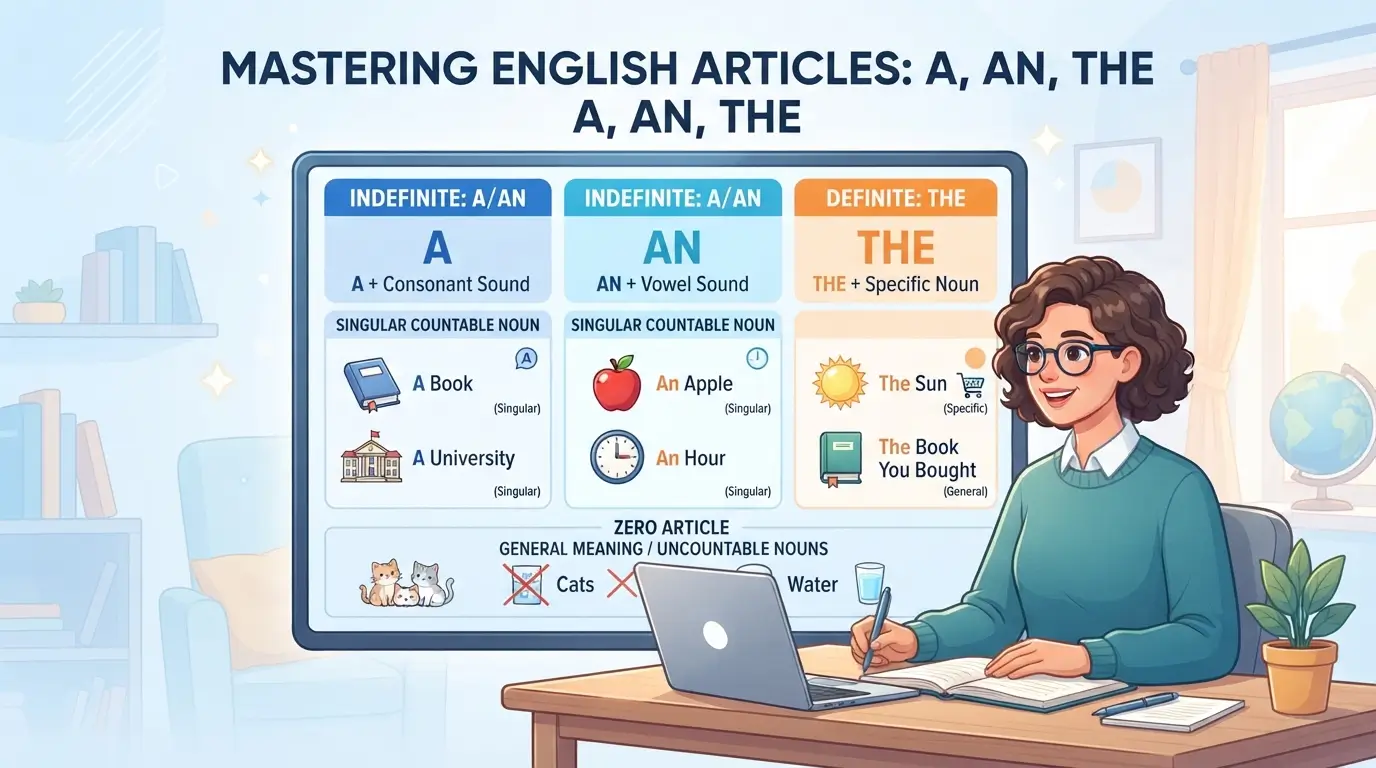
Fig. 1 — The four article choices in English
When to Use A
Use a before a singular countable noun when the following word starts with a consonant sound.
A book, a car, a teacher, a hotel, a university, a European country.
Notice the rule tracks sound, not spelling. "She studies at a university" — university starts with the letter u, but it's pronounced with a "yoo" sound, which counts as a consonant. So "a university" is correct, even though it looks like it should take "an."
Other examples: "He is a useful employee." "She wants to buy a European car." "We visited a university near the city." A few more in context: "I need a new laptop." "She works as a manager." "He found a wallet on the street." "We stayed in a small hotel."
When to Use An
Use an before a singular countable noun when the following word starts with a vowel sound.
An apple, an engineer, an idea, an office, an hour, an honest person.
Pronunciation matters more than spelling here too. "We waited for an hour" — the h in hour is silent, so the word effectively opens with a vowel sound. Same story with "She is an honest person," where the h in honest disappears entirely.
More in context: "He is an engineer." "I had an idea." "She bought an expensive phone." "We waited for an hour." "It was an unusual experience."
A vs. An: The Easy Rule
The rule itself is simple enough: a goes before a consonant sound (a car, a book, a university); an goes before a vowel sound (an apple, an engineer, an hour).
| Article | Use Before | Examples |
|---|---|---|
| a | Consonant sound | a car, a book, a university |
| an | Vowel sound | an apple, an engineer, an hour |
What trips people up is deciding based on the letter rather than the sound. "A university" is correct; "an university" isn't, even though u looks like a vowel. "An hour" is correct; "a hour" isn't, even though h looks like a consonant.
When to Use The
The is the definite article — used when a noun is specific, already known, unique, or clear enough from the situation that no further explanation is needed.
When Something Was Already Mentioned
A common pattern: introduce something with a/an, then switch to the once it's already on the table. "I saw a dog near my house. The dog was wearing a red collar." The first mention introduces an unknown dog; the second refers back to that exact one.
When Both People Know What You Mean
Sometimes a noun doesn't need a prior mention at all, because the situation itself makes the reference obvious. "Please turn off the light" works fine in a room with one obvious light — the listener already knows which one.
Same logic: "Please open the door." "Where is the bathroom?" "Can you pass me the salt?"
For Unique Things
The also covers things that are unique, or treated as unique in a given context: the sun, the moon, the Earth, the internet.
"The sun is very bright today" doesn't need clarifying — there's only one sun in the conversation.
With Superlatives
The shows up before superlative forms too: the best, the fastest, the most expensive, the most interesting.
"This is the best restaurant in the area" — superlatives, by definition, point at one specific thing above all the others, so the fits naturally.
A/An vs. The: What's the Difference?
Context tends to be the clearest way to see the difference.
"I bought a phone yesterday" — one phone, unidentified. Later: "The phone has a very good camera" — now it's clear which phone's being discussed.
"She wants to rent a car" — any suitable car would do. "She wants to rent the car we saw yesterday" — now a specific car is meant.
Rough summary: a/an signals general, new, or unidentified; the signals specific, known, or identifiable.
When Do You Use No Article?
English doesn't always require an article. Sometimes the correct answer is no article at all — sometimes called the zero article — and this shows up especially often when speaking generally.
General Plural Nouns
Talking about plural nouns in general usually skips the article entirely. "Dogs are loyal animals" means dogs as a category. Compare "The dogs in my neighborhood are very friendly" — now a specific group's being discussed, so the returns.
Uncountable Nouns
Plenty of uncountable nouns skip a or an when used generally: water, information, advice, music, education, money.
"Water is necessary for life." "Information is easy to find online." "Music can help people relax." "She gave me advice." None of these need an article in their general sense.
Once the noun becomes specific, though, the can step back in: "The information in this email is useful" — now it's particular information, not information in general.
Articles with Countable and Uncountable Nouns
Countable Nouns
Countable nouns can be counted individually: one book, two books, one car, three cars, an apple.
A singular countable noun normally needs an article or some other determiner attached. "I bought a book" works; "I bought book" doesn't. Same with "She has a car" versus "She has car," or "He is an engineer" versus "He is engineer."
Uncountable Nouns
Uncountable nouns don't usually get counted as separate units: information, advice, water, furniture, music.
"An information," "an advice," and "a furniture" all sound wrong, because these nouns resist that kind of counting. Instead: some information, a piece of advice, a bottle of water, a piece of furniture.
For a specific instance, the still works: "I need the information you sent me."
Articles Before Adjectives
Sometimes an adjective sits between the article and the noun, and the article still tracks the sound directly following it — not the noun itself.
A good job. A useful tool. An interesting book. An expensive restaurant. The old building.
Notice "an interesting book" — the article's choice comes from the vowel sound opening interesting, not from book, which sits further down the sentence.
Articles and Possessive Words
A, an, and the don't normally sit directly in front of possessive determiners like my, your, his, her, our, or their.
"My car," "your phone," "her office," "their house" are all correct as they stand. "The my car," "a your phone," "the their house" all sound broken, because the possessive word is already doing the identifying work an article would otherwise do.
"This is my book" needs nothing extra in front of "my" — it's already specific.
Common English Article Mistakes
Mistake 1 — Forgetting an article.
✗ I am student.
✓ I am a student.
A singular countable noun like "student" normally can't stand alone without an article or some other determiner.
Mistake 2 — Using "a" instead of "an."
✗ She is a engineer.
✓ She is an engineer.
"Engineer" opens with a vowel sound.
Mistake 3 — Using "an" instead of "a."
✗ He studies at an university.
✓ He studies at a university.
"University" opens with a "yoo" consonant sound, regardless of the spelling.
Mistake 4 — Adding "the" to general nouns.
✗ The life is difficult.
✓ Life is difficult.
The first version implies a particular kind of life, or a specific context. The second speaks about life in general, which is usually what's actually meant.
Mistake 5 — Using "a/an" with uncountable nouns.
✗ She gave me an advice.
✓ She gave me some advice. / She gave me a piece of advice.
Mistake 6 — Using "the" when you mean things generally.
"I like music" means music broadly. "I like the music at this restaurant" points at something specific. The article is what shifts the meaning between the two.
Special Cases You Should Know
Some article patterns make more sense as memorized phrases than as isolated rules.
Go to School vs. Go to the School
"I go to school every day" usually describes attending school as a student. "I went to the school to speak with the principal" refers to a specific building or institution instead.
Go Home vs. Go to the Home
"I went home after work" is the normal phrasing — not "I went to the home after work." That said, "the home" can be correct when it's genuinely referring to a specific home or institution.
General vs. Specific
"I like coffee" means coffee generally. "I like the coffee at this café" means something specific — the coffee served at that particular place. Same noun, different article, genuinely different meaning.
English Articles in Everyday Conversation
At a Restaurant
"I'd like a coffee, please" — one serving, unspecified. "Can you pass me the menu?" — a specific menu both people already know about.
At Work
"I need a meeting with my manager" — one meeting, not yet identified. "The meeting starts at 10" — now it's specific and known.
While Shopping
"I'm looking for a laptop" — any suitable one would do. "I'm looking for the laptop I saw online" — now a particular laptop's in mind.
Common Expressions with Articles
Certain expressions come with a fixed article pattern that's easier to just memorize as a phrase: in a hurry, take a break, on the phone, play the piano, go to bed, go to school, at home.
These are worth noticing while reading or listening, since article use in fixed expressions doesn't always translate cleanly from a first language.
How to Improve Your Use of English Articles
Learning the rules is only the starting point. Article use tends to click once the patterns show up repeatedly in real English, not just in a grammar table.
Read Short English Texts
News articles, blogs, stories, workplace material — read with an eye specifically on a, an, and the. Worth asking: why "a" here? Why "the" there? Could this noun be general? Is it actually specific?
Listen to Natural English
Podcasts, interviews, videos, ordinary conversation — all of it lets you notice how native speakers use articles without consciously running the rule in their head. Pronunciation especially helps sharpen the a/an distinction.
Write Your Own Sentences
Rather than only memorizing the rule, build sentences from an actual day: "I bought a new notebook." Then: "The notebook is on my desk." That progression from unspecified to specific is exactly the pattern worth practicing.
Read Your Sentences Aloud
Saying examples out loud tends to reveal whether an article actually sounds right. Worth paying attention to words like university, European, honest, hour, and engineer specifically, since these are the ones that trip up the sound-based rule.
Learn From Mistakes
Finding an article mistake in your own writing is worth more than a quick fix — asking why the original choice was wrong tends to build the pattern-recognition that eventually makes this automatic.
English Articles Practice Exercise
Choose a, an, the, or no article (—):
- I bought ___ new laptop yesterday.
- She is ___ engineer.
- We waited for ___ hour.
- Please close ___ door.
- ___ dogs are loyal animals.
- I need ___ information about the course.
- He studies at ___ university in London.
- She gave me ___ piece of advice.
- ___ sun is shining today.
- I love ___ music.
- I watched ___ movie last night. ___ movie was very funny.
- He wants to become ___ teacher.
Show Answers
1. a · 2. an · 3. an · 4. the · 5. — · 6. — · 7. a · 8. a · 9. The · 10. — · 11. a, The · 12. a
The goal isn't simply memorizing the answers. Trying to explain why each article fits tends to build a considerably stronger grip on the rules than the answer key alone ever could.
Quick Guide to A, An, The, and No Article
| Situation | Article | Example |
|---|---|---|
| One non-specific singular countable noun | a | a book |
| One non-specific noun beginning with a vowel sound | an | an apple |
| Specific or known noun | the | the book on my desk |
| Something unique | the | the sun |
| General plural noun | no article | Books can be useful. |
| General uncountable noun | no article | Water is essential. |
| Specific uncountable noun | the | the water in this bottle |
| Possessive determiner | no article | my book |
Frequently Asked Questions
What are the three articles in English?
The three English articles are a, an, and the. A and an are indefinite articles, while the is the definite article.
What is the difference between a and an?
The choice depends on sound. Use a before a consonant sound and an before a vowel sound — a university, a European country, an apple, an hour.
When should I use the?
Use the when the noun is specific, already known, previously mentioned, unique, or clear from context — "I bought a book. The book is about history."
Can I use a or an with plural nouns?
No. A and an go with singular countable nouns only. "A book" works; "a books" doesn't. For plural nouns, use no article for a general meaning, or the for a specific group.
Can I use a or an with uncountable nouns?
Normally not. "An information" and "a water" don't work in their standard uncountable sense. Instead: some information, a piece of information, some water, a bottle of water.
Why is it "a university" but "an hour"?
Because article choice depends on pronunciation, not spelling. "University" begins with a "yoo" consonant sound, so it takes a. "Hour" begins with a vowel sound because the h is silent, so it takes an.
Do I always need an article before a noun?
No. English often uses no article with general plural nouns and many general uncountable nouns — "Dogs are friendly," "Information is useful." Singular countable nouns, though, normally do need an article or another determiner.
Sound First, Specificity Second
English articles look like tiny grammar words, and yet they carry a genuinely large amount of information for their size. A and an usually introduce a non-specific singular countable noun. The points at something specific, known, or identifiable. And plenty of situations call for no article at all, particularly with general plural and uncountable nouns.
The most useful habits, in the end, come down to two checks: listen to the actual sound when choosing between a and an, and think about specificity when deciding whether the belongs.
None of this needs mastering in a single sitting. Reading real English, noticing how articles actually get used, writing your own examples, and practicing regularly tends to work far better than memorizing a rule table. Given enough exposure, most of these choices start to feel automatic rather than like something you have to calculate each time.