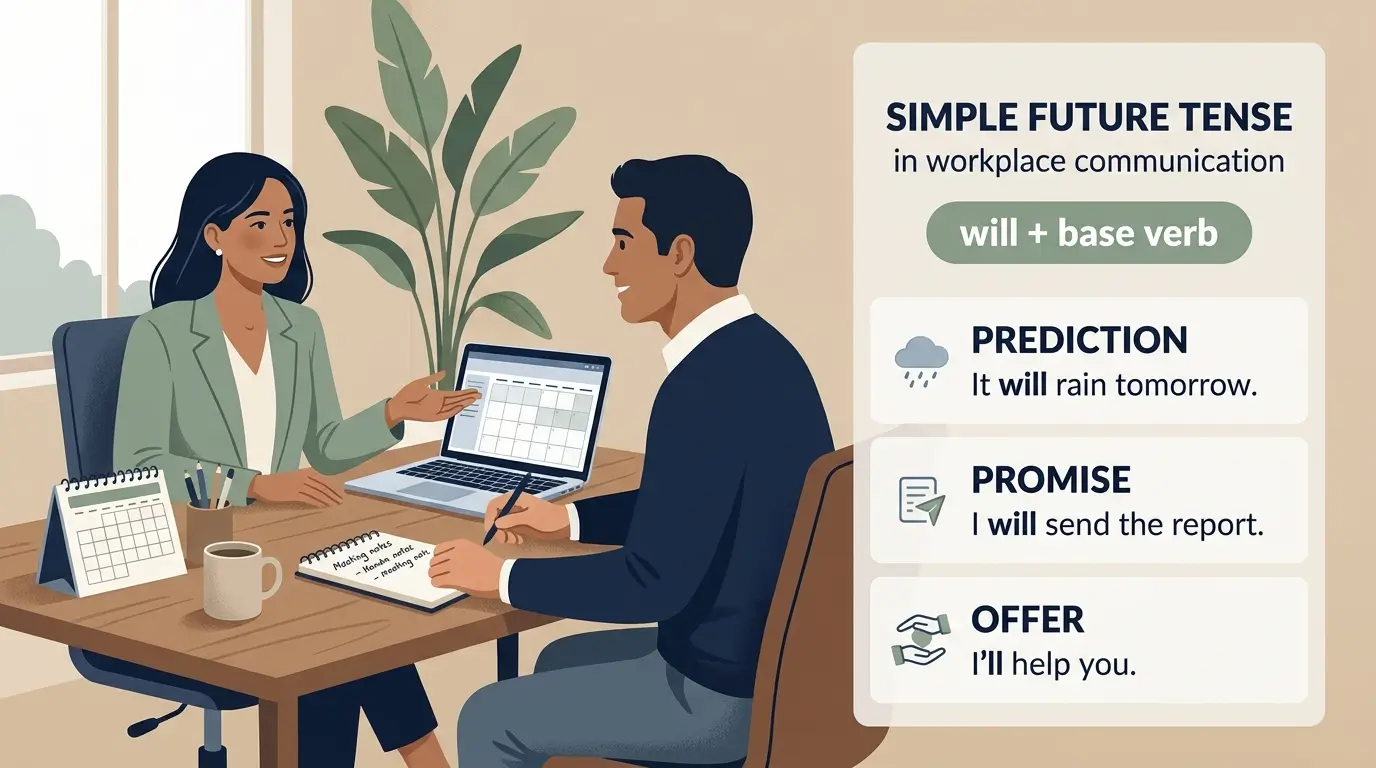
Much of what people say at work and at home is about things that haven't happened yet. A forecast, a promise, an offer of help, a quick decision when something comes up unexpectedly. The simple future with will covers all of that, which probably explains why it's one of the first tenses learners meet.
"I will call you after work." "She will probably pass the exam." "Don't worry. I'll help you." "They will arrive tomorrow morning." Each one pairs will with the base form of a verb, and that's more or less the whole structure.
The harder part is judging when will is the right choice and when English offers something better, such as going to or the present continuous. This guide covers the formula, the main uses, the common slips, and a short exercise.
What Is the Simple Future Tense?
The simple future describes an action or situation expected to happen after the present moment. It's usually built from the auxiliary will plus the base form of the main verb.
"I will start my new job next Monday." "We will discuss the proposal tomorrow." "The weather will become colder tonight." "He will be available after lunch."
It tends to carry predictions, promises, offers, and decisions made on the spot. English has other ways to talk about the future, though, and the best one depends on what you want to express.
Simple Future Tense Formula
The structure: subject + will + base form of the verb. The verb after will never changes, whoever the subject is. I, you, he, she, it, we, and they all follow the same pattern.
| Sentence Type | Formula | Example |
|---|---|---|
| Affirmative | Subject + will + verb | She will join the meeting. |
| Negative | Subject + will not + verb | She will not join the meeting. |
| Question | Will + subject + verb? | Will she join the meeting? |
| Wh-question | Question word + will + subject + verb? | When will she join the meeting? |
In everyday speech, will not usually shrinks to won't: "I won't forget your advice." "They won't attend the event." "He won't be late."
Fig. 1 — Simple future tense structure at a glance
Positive Sentences
Will followed by the base verb: "I will finish the report today." "She will learn the new software." "We will visit our relatives this weekend."
Negative Sentences
Put not after will: "I will not accept the offer." "He will not come to the office tomorrow." "We won't need extra time."
Questions
Will moves before the subject: "Will you attend the interview?" "Will they finish the work today?" For information questions, start with the question word: "Where will you stay?" "What will they discuss?" "How will we solve this problem?"
When Do We Use the Simple Future?
1. Predictions
Will works well for what you expect to happen, especially when it's an opinion rather than something you can see coming.
"I think the team will win the match." "It will probably rain this evening." "This course will help you improve your English." Words like think, believe, probably, and perhaps often show up with predictions, though they aren't required.
2. Spontaneous Decisions
When you decide something at the moment of speaking, rather than following an earlier plan, will is the natural choice.
"The phone is ringing. I'll answer it." "I forgot my notebook. I'll get one from the office." "You're carrying too many bags. I'll help you." The decision is a reaction to what's happening right now.
3. Promises
Will carries a sense of commitment, so it suits promises and assurances.
"I will keep your information private." "I'll send you the documents tonight." "I won't tell anyone about your plans."
4. Offers and Willingness
It also shows you're willing to do something for someone else: "I'll carry that box for you." "We will help you prepare for the presentation." "I'll explain the instructions again."
One small point on offers phrased as questions: "Shall I get you a glass of water?" is the usual form. "Will I get you a glass of water?" sounds off, because will asks about the future rather than offering.
5. Future Events and Situations
Will can simply describe something expected later: "The conference will begin at 9 a.m." "The new office will be ready next month." "You will receive a confirmation email soon."
For fixed official timetables, the simple present is often more natural: "The train leaves at 7 a.m."
Common Time Expressions
| Time Expression | Example |
|---|---|
| tomorrow | I will call you tomorrow. |
| soon | The results will be available soon. |
| later | She will speak to you later. |
| next week | We will start the training next week. |
| next month | They will move next month. |
| in the future | More people will work remotely in the future. |
| in a few minutes | The meeting will begin in a few minutes. |
These can sit at the start or the end of a sentence, depending on what you want to emphasize.
Simple Future vs. "Going To"
Both can refer to the future, but they often signal different things.
| Will | Be Going To |
|---|---|
| Decisions made at the moment of speaking: "I'll order some food." | Plans already formed: "I'm going to cook dinner tonight." |
| Predictions based on belief: "I think she will win." | Predictions based on present evidence: "Look at those clouds. It's going to rain." |
These are tendencies, not strict rules. In plenty of situations both are possible, with a slight shift in emphasis.
The present continuous is also useful for arrangements already made: "I'm meeting my manager tomorrow." "We're visiting our clients on Friday." Choosing between the three forms mostly comes down to whether you're predicting, intending, or arranging.
Common Mistakes to Avoid
Mistake 1 — Adding -s after the main verb.
✗ She will goes to work tomorrow.
✓ She will go to work tomorrow.
After will, always use the base form.
Mistake 2 — Using "to" after will.
✗ I will to call you later.
✓ I will call you later.
Mistake 3 — Wrong word order in questions.
✗ You will attend the meeting?
✓ Will you attend the meeting?
Mistake 4 — Mixing will and going to.
✗ I will going to study tonight.
✓ I am going to study tonight.
Pick one structure. Don't combine them.
Mistake 5 — Using will inside a time clause.
After when, before, after, and until, English normally uses the present simple, even though the meaning is future.
✗ I will call you when I will arrive.
✓ I will call you when I arrive.
Simple Future Tense Exercises
Complete each sentence using the correct form of the verb in brackets:
- I ________ you after the meeting. (call)
- She ________ attend the training tomorrow. (not)
- ________ they ________ us next weekend? (visit)
- I think the weather ________ colder tonight. (become)
- Don't worry. We ________ you with the presentation. (help)
- When he ________ home, he will send us a message. (arrive)
Show Answers
1. will call · 2. will not / won't · 3. Will / visit · 4. will become · 5. will help · 6. arrives
Notice the last answer: the time clause after "when" takes the present simple, even though the sentence refers to the future.
Quick Reference Guide
| Sentence Type | Structure | Example |
|---|---|---|
| Positive | Subject + will + base verb | They will arrive soon. |
| Negative | Subject + will not / won't + base verb | They won't arrive late. |
| Question | Will + subject + base verb? | Will they arrive soon? |
In informal conversation, contractions are the norm: I'll, you'll, he'll, she'll, we'll, they'll. In formal writing, the full form will may suit the context better.
Frequently Asked Questions
What is the simple future tense?
It describes actions or situations expected to happen after the present moment, commonly formed with will plus the base form of a verb.
What is the formula for the simple future tense?
Subject + will + base verb. For example: "She will start work tomorrow."
How do I make a negative sentence in the simple future?
Add not after will: "I will not attend the meeting." The contraction won't is common.
How do I ask a question in the simple future?
Place will before the subject: "Will you come tomorrow?"
What is the difference between "will" and "going to"?
Will often expresses spontaneous decisions and predictions based on belief. Going to often describes existing intentions or predictions based on present evidence.
Which time expressions are used with the simple future?
Tomorrow, soon, later, next week, next month, and in the future are common.
Does the verb change after "will"?
No. The main verb stays in its base form: "He will work," not "He will works."
Can I use contractions with the simple future tense?
Yes: I'll, you'll, he'll, she'll, we'll, and they'll. The negative contraction is won't.
Can I use the simple future for promises?
Yes. "I will help you prepare for the interview" expresses a commitment.
Should I use "will" after "when" to talk about the future?
Usually not. In a time clause, use the present simple: "I'll call you when I arrive," not "when I will arrive."
Will for the Moment, Going To for the Plan
The simple future is a practical piece of everyday English. It lets you predict, promise, offer, and react to whatever comes up mid-conversation.
A sensible way to build it: practice the pattern will plus base verb, write a few positive sentences, turn them into negatives, then ask questions. Describing what you expect to do tomorrow, or what you think will happen at work this month, works well as a real-life exercise.
With regular use, choosing between will, going to, and the present continuous tends to become a matter of instinct rather than calculation.