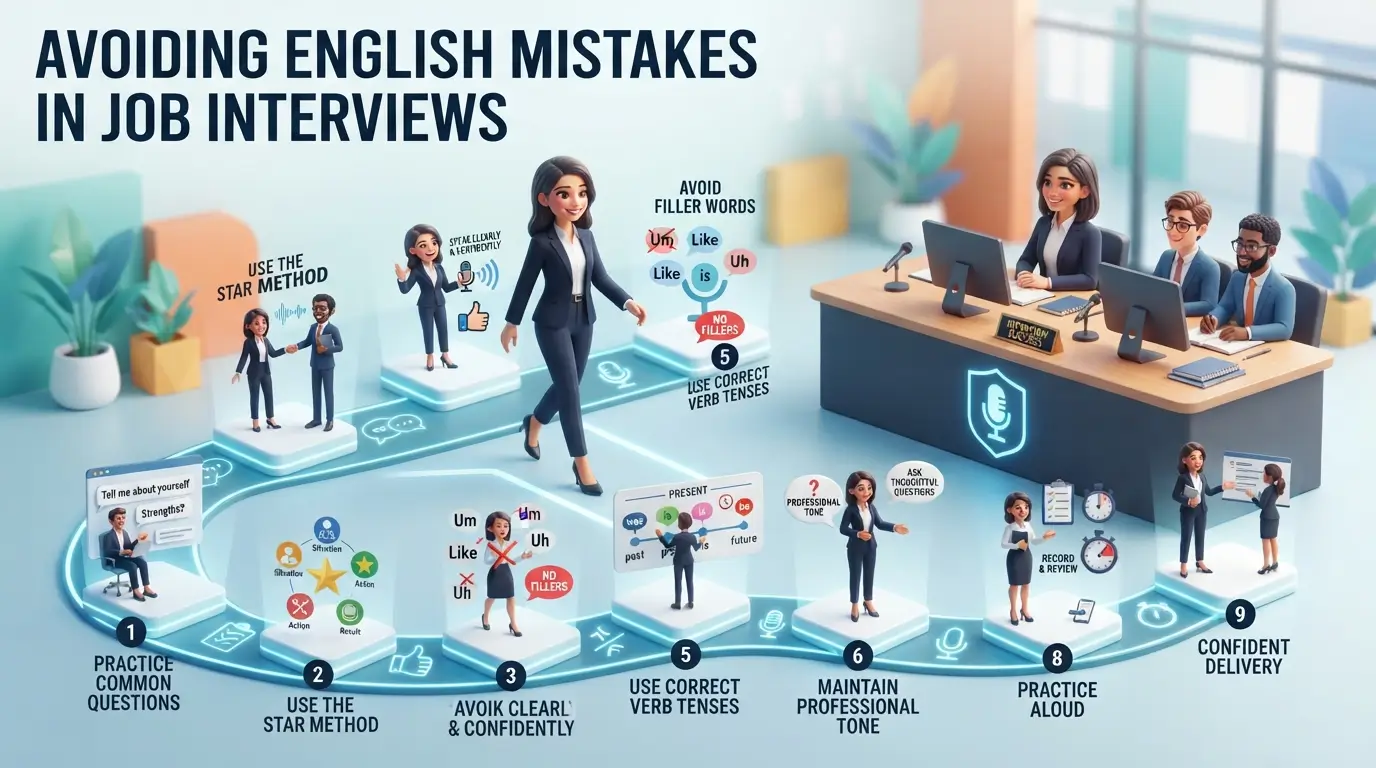
A job interview is stressful under the best circumstances, and that stress tends to compound when English isn't your first language. You might know exactly the right answer and still stumble getting it out clearly.
The reassuring part: most of the mistakes that actually hurt interview performance are avoidable, and avoidable with fairly modest preparation.
Here are the mistakes that come up again and again in English-language interviews, along with what tends to work better instead.
1. Not Preparing for Common Questions
Walking into an interview without any preparation tends to produce answers that come out unclear, or oddly short, or both.
A handful of questions show up in nearly every interview, regardless of industry: "Tell me about yourself." "Why do you want this job?" "What are your strengths and weaknesses?" "Why did you leave your previous job?" "Where do you see yourself in five years?"
There's no need to memorize a complete script for each one. A few solid key points per question tend to get you further than a rehearsed paragraph would.
2. Giving Answers That Are Too Long
Some candidates try to cram in everything they know about a topic, and the answer ends up harder to follow rather than more impressive.
A tighter approach usually works better: answer the actual question directly, give one relevant example, then explain what came of it.
For experience-based questions specifically, the STAR method tends to hold up well — situation, task, action, result. Briefly set the scene, explain what needed doing, describe what you actually did, and say what happened as a result. That structure alone keeps most answers from sprawling.
3. Using Too Many Filler Words
Words like um, uh, like, and you know show up constantly in ordinary conversation, but leaning on them repeatedly during an interview tends to read as less confident than the speaker probably feels.
Rather than filling every pause with a sound, a short beat of actual silence works better. "That's a good question. Let me think for a moment" buys the same thinking time without the verbal clutter — and a brief pause generally lands better than a string of filler ever does.
4. Speaking Too Quickly
Nerves tend to speed people up without them noticing, which can make pronunciation genuinely harder to follow.
Worth aiming for: a comfortable pace, a pause between separate ideas, clear pronunciation on the words that actually carry the meaning, and a breath before launching into an answer.
None of this requires sounding like a native speaker. Clear communication matters considerably more than a flawless accent ever will.
5. Using the Wrong Verb Tense
Interview answers move between tenses constantly, often within the same response.
Present: "I manage a small team." Past: "I managed a small team in my previous role." Future: "I hope to develop my leadership skills."
Fig. 1 — Interview answers often shift between all three tenses
Practicing all three before the interview — current responsibilities, past experience, future goals — tends to smooth this out considerably.
6. Memorizing Every Answer
A fully memorized script tends to sound exactly like what it is, and it falls apart the moment an interviewer phrases a familiar question slightly differently.
Preparing ideas rather than exact sentences leaves room to respond naturally, even when the question doesn't arrive in quite the form you rehearsed.
7. Speaking Too Formally or Too Casually
Interviews call for a tone somewhere in the middle — professional, but not stiff.
"Yeah, I kinda did that." "My boss was pretty annoying." "I just wanted a better job." All of these lean too casual for the room.
"Yes, I was responsible for that." "I learned a lot from my previous manager." "I was looking for an opportunity to develop my skills." Same underlying content, considerably more professional delivery.
8. Speaking Negatively About a Previous Employer
Even a genuinely difficult past job is rarely worth criticizing out loud in an interview, however satisfying it might feel in the moment.
Redirecting toward what you learned, and what you're actually looking for next, tends to land better: "I'm looking for a position where I can take on more responsibility and continue developing professionally."
9. Not Asking Questions
Interviews almost always end with some version of "Do you have any questions for us?" — and answering "No" tends to read as underprepared, even when that's not the case.
Worth having ready: "What would success look like in this position?" "What does a typical day look like?" "What opportunities are there for professional development?"
10. Not Practicing Out Loud
Reading through answers silently isn't the same skill as saying them. Speaking out loud surfaces pronunciation issues, grammar slips, and awkward sentence structures that silent reading simply doesn't reveal.
Recording yourself answering five common questions, then listening back critically, tends to expose exactly where the rough edges are.
Common English Mistakes to Watch
| Instead of | Say |
|---|---|
| "I am working here since 2022." | "I have been working here since 2022." |
| "I have good communication." | "I have good communication skills." |
| "I did many responsibilities." | "I had many responsibilities." |
| "I am agree." | "I agree." |
| "I am interested for this job." | "I am interested in this job." |
What If You Make a Grammar Mistake?
Worth not panicking over. Small grammar slips rarely derail an entire interview on their own.
Noticing the mistake and correcting it mid-sentence works fine: "I worked—sorry, I mean, I have worked in customer service for three years."
Staying calm through a correction tends to leave a better impression than straining for flawless grammar in the first place.
Final Interview Checklist
Before walking in, it's worth confirming you can:
- ☐ Introduce yourself clearly.
- ☐ Explain your experience.
- ☐ Answer common questions.
- ☐ Give examples using the STAR method.
- ☐ Speak at a comfortable speed.
- ☐ Use professional language.
- ☐ Ask the interviewer a few questions.
This Isn't an English Exam
An English-language job interview was never really testing your English the way a classroom exam would.
What's actually being evaluated is whether you can communicate your skills, your experience, and something of your personality clearly enough for the interviewer to picture you doing the job. Grammar matters to the extent that it serves clarity — it was never really the point on its own.
With enough regular practice, all of this tends to get considerably more comfortable: introducing yourself, walking through your experience, answering the expected questions, structuring an example with STAR, keeping a reasonable pace, and asking something genuine in return.
Frequently Asked Questions
What is the biggest mistake in an English job interview?
Giving unclear or overly long answers tends to be the most common one. Staying focused on the actual question, rather than everything adjacent to it, usually helps most.
How can I improve my English before an interview?
Practicing common questions out loud, recording yourself, and reviewing your own pronunciation and grammar tend to make a genuine difference in a short amount of time.
Do I need perfect English to pass a job interview?
Not necessarily. Clear communication, relevant experience, preparation, and a reasonable amount of confidence usually matter more than flawless grammar.
What should I do if I don't understand an interview question?
Politely asking the interviewer to repeat or clarify it works better than guessing — something like "Could you please clarify what you mean?" tends to be all it takes.