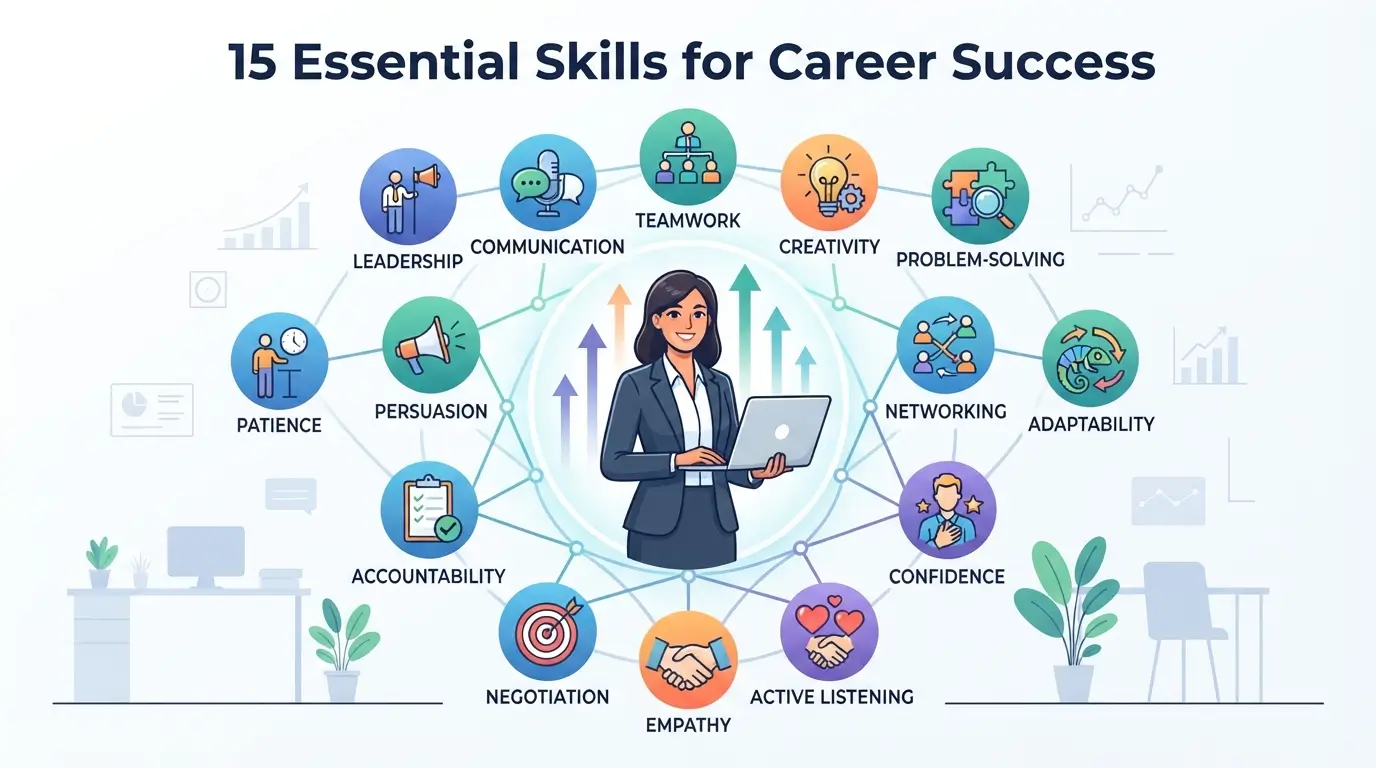
Experience and technical know-how can get you pretty far in a career, but they were never the whole story, whatever a job posting might imply. As workplaces keep shifting, what tends to distinguish people also includes communication, problem-solving, interpersonal skill, and something like leadership — even without the title attached.
Getting ahead usually comes down to a mix of technical ability and personal qualities that make someone reliable, adaptable, and genuinely easy to work alongside.
None of this requires mastering all fifteen at once. Picking out where the actual gaps are, and working on those consistently, tends to matter more than trying to improve everything simultaneously.
Here are fifteen skills worth developing if career growth is the goal.
1. Accountability
Being willing to actually own your work is one of those qualities that quietly shapes how much people trust you. Accountability means understanding what you're responsible for, meeting the commitments you've made, and accepting the results of your own decisions — good or bad.
When something goes wrong, the instinct to immediately point elsewhere is worth resisting. Acknowledging what happened, considering what could've gone differently, and moving toward a fix tends to build far more trust than deflecting ever does.
Managers notice this pattern over time, and that noticing tends to translate into more responsibility, not less.
2. Adaptability
Workplaces rarely hold still for long. New technology, new processes, new expectations — something's always shifting, whether anyone asked for it or not.
Adaptability just means being willing to learn and adjust once circumstances actually change. Rather than treating every shift as an inconvenience, it helps to ask why it's happening and what there might actually be to learn from it.
People who stay reasonably flexible tend to absorb new responsibilities more easily, and tend to stay relevant as their field moves on around them.
3. Networking
A professional network can surface opportunities you'd genuinely never stumble onto alone.
Networking doesn't require formal events and a stack of business cards, whatever the stereotype suggests. It can be as simple as an actual conversation with a colleague, joining a professional community, showing up to an industry event, or connecting with someone on a professional platform.
Good networking runs both directions too — it's not only about asking for help. Building real relationships, sharing something useful now and then, and looking for small ways to support other people tends to matter as much as anything you'd ask for in return.
4. Focus
Modern workplaces make sustained concentration genuinely hard. Emails, meetings, notifications, three overlapping assignments — all of it competes for the same limited attention.
Building better focus tends to mean doing meaningful work rather than just staying visibly busy all day.
Identifying the most important task before the day gets away from you, working on it during whatever window has the fewest interruptions, and cutting unnecessary distractions where possible — these small habits add up more than people expect.
Being able to actually concentrate on what matters is valuable in nearly any profession, technical or not.
5. Active Listening
Communication was never only about speaking clearly. Listening carefully is at least half of it.
Active listening means paying real attention to what someone's actually saying, asking a question when something's unclear, and understanding the full situation before jumping to a response.
At work, this tends to prevent misunderstandings before they start, and it tends to lead to better decisions too. When a colleague explains a problem, hearing the whole thing before offering a fix usually beats solving half a problem quickly.
People also tend to notice, and appreciate, colleagues who make them feel genuinely heard.
6. Creativity and Innovation
None of this requires being an artist or an inventor. Workplace creativity mostly means finding a better way to solve a problem, tighten a process, or serve a customer slightly better than before.
Rather than doing something purely because it's always been done that way, it's worth occasionally asking: is there a simpler way to do this? What's actually causing the problem? Could technology handle part of this more efficiently? What would genuinely improve things for a customer or a colleague?
Small, practical improvements tend to matter more than dramatic ones — provided they're actually well thought through.
7. Confidence
Confidence helps you actually say what you think and take responsibility for the decisions that follow. It's a genuinely different thing from arrogance, though the two get confused often enough.
A confident professional can state an opinion while staying open to a different one. Saying what you actually think, asking a real question, and admitting when you don't know something — all of that fits comfortably under confidence, contrary to how it sometimes gets framed.
Confidence tends to build through preparation and repetition more than anything else. The more a skill gets practiced, and the more mistakes get absorbed and learned from, the more comfortable most people become in situations that once felt uncertain.
8. Leadership
Leadership was never limited to whoever happens to hold a manager title.
It shows up in taking initiative, helping a colleague who's stuck, solving a problem nobody assigned to you specifically, organizing a project that needed organizing, or encouraging someone through a rough patch.
Good leaders don't just issue instructions. They communicate what's actually expected, listen to the people around them, make reasonably responsible calls, and help others do their best work.
Building this early tends to prepare someone for whatever management responsibility comes later, whether or not that's the explicit goal.
9. Communication
Strong communication shows up in essentially every career, regardless of field.
Writing an email that actually gets read the way it was intended, explaining an idea clearly, holding your own in a meeting, giving a presentation, talking with a customer, working through a problem with a colleague — communication threads through all of it.
Effective communication tends to be clear, respectful, and matched to the actual situation. Skipping unnecessary jargon and making sure the message lands the way it was meant to tend to matter more than sounding impressive.
Good communication also cuts down on misunderstandings, which tends to make an entire team move faster.
10. Teamwork
Most workplaces depend on people actually working together, and even a genuinely skilled individual can struggle if collaboration doesn't come naturally.
Being a solid team player means contributing your own skills while still respecting what colleagues are responsible for and what they bring to the table.
Good teamwork tends to include sharing information freely, meeting your own commitments, helping out when it makes sense, and handling disagreement without letting it curdle into something personal.
Employers tend to value people who can work independently and still add something real to a group — not one or the other.
11. Persuasion
Persuasion matters anytime you need someone else to actually understand or get behind an idea.
Maybe it's convincing a customer to choose one product over another, getting a manager to seriously consider a proposal, or nudging a team toward trying something different than usual.
Genuine persuasion isn't manipulation dressed up nicely. It's understanding what the other person actually needs, building an argument that holds together logically, and explaining the benefit in terms that land for them specifically.
Learning to make a genuinely convincing case tends to matter more, not less, as responsibility grows.
12. Negotiation
Negotiation shows up more often than the word itself suggests — a salary conversation, sure, but also a project deadline, or smoothing over a disagreement between two people on the same team.
Successful negotiation tends to start with listening, not talking. Understanding what the other side actually needs, finding where there's already agreement, and looking for something reasonable for everyone involved tends to work better than pushing hard for one specific outcome.
Staying prepared, calm, and respectful throughout tends to make even a genuinely difficult negotiation considerably more manageable.
13. Empathy
Empathy means actually trying to see a situation from someone else's angle — their feelings, their concerns, their actual perspective, not just your read on it.
Workplaces mix together people with different personalities, backgrounds, and pressures nobody else can fully see. Understanding how a colleague might be experiencing a given moment tends to make communication genuinely more effective.
If a colleague is struggling with a hard assignment, meeting that with patience tends to help more than immediate criticism ever would — even when the criticism happens to be accurate.
Empathy strengthens working relationships over time, and it tends to make the whole environment a little healthier to actually work in.
14. Problem-Solving
Every career runs into problems eventually — a deadline shifts, a customer complains, a project slips, a process that used to work suddenly doesn't.
Strong problem-solving lets you respond to that instead of just absorbing the stress of it.
Facing a problem, it helps to identify the actual cause before deciding what to do about it. Breaking the situation into smaller pieces, weighing a few possible solutions, and thinking through likely outcomes tends to beat reacting on instinct.
Being able to solve things independently, while still knowing exactly when to ask for help, tends to make someone considerably more dependable to a team.
15. Patience
Patience rarely makes it onto a typical list of career skills, and it probably should more often.
Work gets stressful — tight deadlines, disagreements, moments where everything seems to hit at once. Reacting emotionally in those moments tends to make a small problem measurably worse.
Patience buys time to actually listen, think, and respond with some intention behind it, rather than firing back the first thing that comes to mind. It tends to help difficult conversations end without damaging the relationship underneath them.
None of this means tolerating genuinely inappropriate behavior. It means holding onto self-control and professionalism while working through something genuinely difficult.
How to Develop These Skills for Career Success
Knowing which skills matter is really only step one. The actual benefit shows up once they get practiced.
Start narrow — two or three areas worth improving is plenty to begin with. Wanting to communicate better might mean volunteering for a presentation, or just practicing clearer workplace emails for a few weeks.
Asking a trusted colleague or manager for honest feedback helps too. Other people tend to notice strengths and blind spots that are genuinely hard to see from the inside.
Fig. 1 — A simple cycle for developing any of these skills
A simple cycle tends to work: identify a skill worth improving, set a specific goal around practicing it, look for real chances to use it at work, ask for honest feedback, review progress every so often, and adjust the approach when it's not quite working.
Career development is mostly gradual, whatever the more dramatic success stories suggest. Small improvements, made consistently, tend to add up to something considerably larger than any single leap ever could.
Small Improvements, Compounded Over Time
Building a genuinely successful career takes more than technical knowledge or a long resume. Employers and colleagues alike tend to notice how someone communicates, handles a problem, responds to change, works alongside others, and takes responsibility when something goes wrong.
The fifteen skills covered here — accountability, adaptability, networking, focus, active listening, creativity, confidence, leadership, communication, teamwork, persuasion, negotiation, empathy, problem-solving, and patience — tend to add up to someone genuinely more capable and more dependable to work with.
Perfection in every one of them was never the actual goal. Continuous improvement, and looking for real chances to apply whatever's being learned, tends to matter considerably more.
The professionals who keep learning, actually accept feedback instead of just hearing it, and adapt as things change tend to be the ones ready for more responsibility when it eventually comes their way.